
Summary
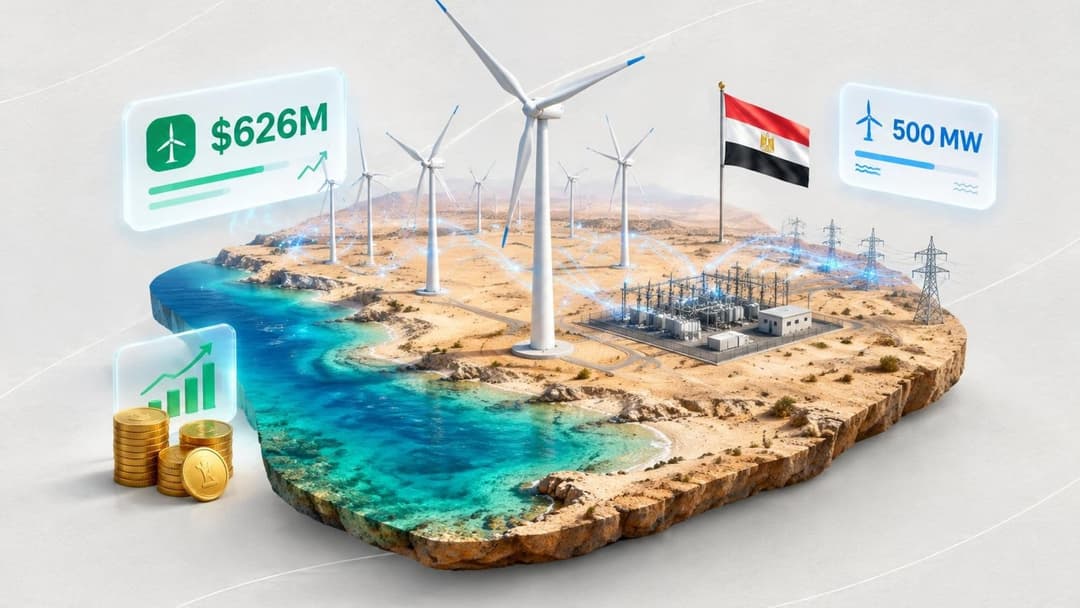
- Alcazar Energy reached a $626M financial close on two Egyptian wind farms.
- The Niat and Rasgha projects in Ras Ghareb total 500 MW.
- EBRD, EIB and DEG provide $436M in debt, one-third each.
- Siemens Gamesa supplies turbines and Orascom Construction builds the balance of plant.
- Commercial operation is expected by the end of 2028.
Alcazar Energy Partners, a sustainable infrastructure fund, has reached financial close on two wind farms on Egypt's Red Sea coast in a deal worth USD 626 million. The Niat and Rasgha projects, both in Ras Ghareb, sit at the heart of a wider programme that pushes the fund's combined investments in Egypt's energy sector past USD 1 billion.
Each wind farm has a planned capacity of 250 MW, so together they add up to 500 MW. Both have secured 25-year power purchase agreements with the Egyptian Electricity Transmission Company (EETC), which is the sort of long-term certainty lenders like to see before they commit.
And commit they did. The projects have secured USD 436 million in debt financing from three European institutions: the European Bank for Reconstruction and Development (EBRD), the European Investment Bank (EIB) and Deutsche Investitions- und Entwicklungsgesellschaft mbH (DEG), a subsidiary of KfW Group. Each lender contributes one-third of the package, and the financing also benefits from European Union guarantee support through the European Fund for Sustainable Development Plus (EFSD+).
The notice to proceed has been issued to Siemens Gamesa Renewable Energy (SGRE), which marks the move from paperwork into execution. Siemens Gamesa contributed to the earlier development work and will supply the turbines as well as provide operation and maintenance services. For the company, these will be its tenth wind project in Egypt, a market it has worked in since 2004.
On the construction side, Orascom Construction will serve as the balance-of-plant contractor. That brings an Egyptian contractor into the heart of the build, alongside the European lenders and technology provider.
Alcazar Energy's own role runs from start to finish. It acquired the development rights to both projects, advanced their development and arranged the financing.
The numbers on output are worth a look. Once operational, the two wind farms are forecast to generate more than 2.3 terawatt-hours of electricity a year and avoid nearly 1.1 million tonnes of CO₂-equivalent emissions annually. They are expected to support around 45 direct operational jobs, plus temporary work during construction. Commercial operation is expected by the end of 2028.
The wind farms are not the fund's only bet on Egypt. In July 2026, Alcazar Energy signed agreements for the USD 420 million privatisation of Gabal El Zeit, a transaction that is still progressing towards its own project-finance close. Together, the two wind projects and Gabal El Zeit represent more than USD 1 billion in combined project and transaction value, including debt and equity. To be fair, the Gabal El Zeit deal remains separate from the close announced for Niat and Rasgha, so it is one to watch rather than one to count just yet.
Around Arageek, we often talk about how hard it is to fund large infrastructure in emerging markets without patient capital. This deal is a neat example of how that capital gets stitched together: development finance institutions, an EU guarantee, a European turbine maker and a local contractor, all lined up behind long-term offtake agreements.
I reckon that blend is the real story here. Egypt is working to expand its renewable capacity and strengthen electricity supply, and projects like Niat and Rasgha show that private infrastructure funds can play a central role in that push, provided the contracts and guarantees are in place. For founders and investors watching the region's energy transition, it is a useful reminder that climate infrastructure is very much a capital-markets story too.
🚀 Got exciting news to share?
If you're a startup founder, VC, or PR agency with big updates—funding rounds, product launches 📢, or company milestones 🎉 — AraGeek English wants to hear from you!
✉️ Send Us Your Story 👇