Summary
- Aramco Ventures has made a strategic investment in Finnish company ROTOBOOST.
- The financial terms and the company's valuation were not disclosed.
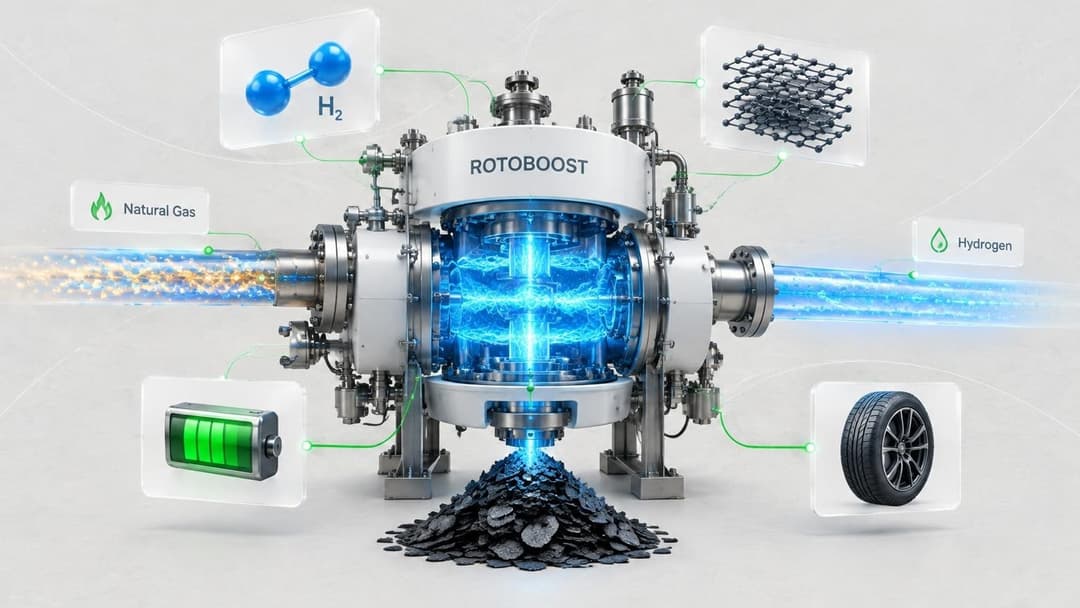
- ROTOBOOST splits methane into low-carbon hydrogen and solid carbon materials.
- The money will fund commercial systems, carbon output and research.
- The company plans to grow in the Middle East, Europe, Asia and North America.
Aramco Ventures, the corporate venturing arm of Aramco, has made a strategic investment in ROTOBOOST, a Finnish energy-transition technology company that splits methane into low-carbon hydrogen and solid carbon materials. The size of the investment and the company's valuation after the deal were not disclosed.
The aim is fairly clear, though. ROTOBOOST wants to move its technology from pilot projects to manufacturing commercial-scale systems, and to strengthen its presence across the Middle East, Europe, Asia and North America.
So what does the company actually do? Founded in 2022, ROTOBOOST uses a process known as methane pyrolysis. A molten catalyst splits natural gas (C1-C6) and other hydrocarbon feedstocks into hydrogen and solid carbon. The carbon is captured in solid form rather than released as carbon dioxide, which is what happens in conventional steam methane reforming. Water electrolysis, the other well-known route, avoids direct carbon emissions but needs a great deal of electricity.
The interesting bit is the business model. Rather than treating the carbon as waste, ROTOBOOST turns it into a product, including crumpled graphene nanoplatelets, an engineered material with a three-dimensional structure. The company is targeting batteries, polymers, anti-corrosion coatings, steel and tyres. In other words, two revenue streams: hydrogen for industry and energy, and advanced carbon materials.
To be fair, the company has already ticked off a few milestones. In May 2025, it and PETRONAS announced a methane pyrolysis pilot that passed 1,000 hours of continuous operation. In June 2025, TÜV SÜD certified the lifecycle carbon footprints of both the hydrogen and the carbon produced by the process. The company also says it holds four approvals in principle for marine applications from ABS, Lloyd's Register, Bureau Veritas and RINA, alongside partnerships with China's Baowu and South Korea's Hankook.
The fresh capital will go towards deploying commercial-scale methane-splitting systems for the oil and gas, power, steel and marine sectors, expanding production capacity for its carbon products, and further research and development on reactor efficiency, feedstock flexibility and carbon product applications.
"ROTOBOOST aims to develop methane-splitting technology to produce hydrogen and solid carbon materials for potential use in batteries, anti-corrosion coatings, and polymers. Through our investment, we aim to support the company's technology development and exploration of commercial opportunities."
That was Zayed Alamri, executive managing director at Aramco Ventures, who added that the investor looks forward to working with the team as it assesses potential industrial applications and builds relationships with prospective customers and partners.
Kaisa Nikulainen, CEO of ROTOBOOST, said the investment supports the company's vision that methane-splitting can drive industrial decarbonisation. "With Aramco Ventures' strategic support and global network, we are well-positioned to scale our technology across key industrial sectors worldwide," she said.
That said, a molten-catalyst reactor is one thing and a repeatable, profitable business is another. The hard questions are the cost of building and running the reactors, the stability of the catalyst, consistent quality of the graphene at commercial volumes, and whether buyers will sign long-term deals for the carbon. Low-carbon is also not zero-carbon: gas extraction, methane leaks and the energy used to run the reactor all count over the full life cycle.
Around Arageek, we often talk about how Gulf corporate venture arms pick their bets, and I reckon this one is spot on for Aramco's playbook: a technology that fits existing gas infrastructure while opening new markets in hydrogen and advanced materials. For the region, it is another sign of the region's big industrial investors backing energy-transition technology abroad, and the next test for ROTOBOOST will be turning pilots into commercial plants.
🚀 Got exciting news to share?
If you're a startup founder, VC, or PR agency with big updates—funding rounds, product launches 📢, or company milestones 🎉 — AraGeek English wants to hear from you!
✉️ Send Us Your Story 👇