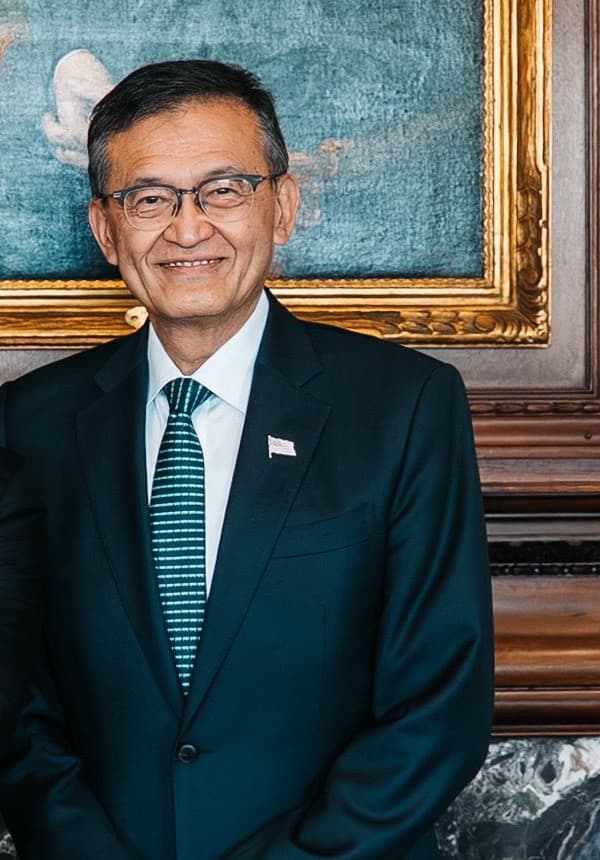
What you do not know
Can the man who led Cadence through twelve years of growth do the same for Intel? Lip-Bu Tan took over the chipmaker in March 2025 and told staff in July that “there are no more blank checks.” Weeks later President Trump demanded his resignation over his business ties to China, then met him at the White House and praised his “amazing story.” By the end of August the US government owned almost a tenth of Intel.
Biography
Lip-Bu Tan was born in Muar, Malaysia, in 1959 and grew up in Singapore, where he studied physics at Nanyang University. He went to the United States for a master’s degree in nuclear engineering at MIT and an MBA from the University of San Francisco. In 1987 he founded Walden International, a venture capital firm that invested in dozens of chip companies. He joined the board of Cadence Design Systems in 2004 and was its chief executive from 2009 to 2021, a period in which its revenue more than doubled. Intel named him CEO in March 2025. Within months he had cut thousands of jobs, faced a call from President Trump to resign, and seen the US government take a stake of almost 10% in the company.
Early Life
Lip-Bu Tan (Chinese: 陈立武) was born on November 12, 1959, in Muar, in the Malaysian state of Johor, into an ethnic Chinese family, the youngest of five children. His father, Tan Keng Lian, was chief editor of the Chinese-language daily Nanyang Siang Pau, and his mother, Chew Yeok Choong, was a warden at Nanyang University in Singapore, so he grew up on the university campus.
As a boy he kept 150 fighting fish and 75 spiders and gave each one a name. He was also a strong basketball player who hoped to turn professional, until his mother told him: “Get yourself a proper job.” He studied physics at Nanyang University and graduated in 1978, at 19.
A Lee Foundation scholarship took him to the Massachusetts Institute of Technology, where he earned a master’s degree in nuclear engineering in 1980. He started a PhD, but after the Three Mile Island accident a professor told him: “There is no future in nuclear engineering. Get out of here.” He left the doctorate unfinished and took an MBA at the University of San Francisco in 1983.
The Personal Life
Tan is a Presbyterian and has been an elder at the First Presbyterian Church of Berkeley since the 1990s. He lives in Piedmont, California, with his wife, Ysa Loo; they have two grown children.
In 2024 he gave S$3 million to Nanyang Technological University to fund a professorship in artificial intelligence, and with Cadence he endowed two professorships at Carnegie Mellon University in 2019.
Quick Facts
- He chose the name Walden to signal a “contrarian, rather than just following the trend” approach.
- In April 2025 Reuters reported that he had invested at least $200 million in Chinese companies between 2012 and 2024, while finding no evidence that he invested directly in firms on the US list of Chinese military companies.
- In July 2025 Cadence pleaded guilty to exporting products to a Chinese military university between 2015 and 2021, during his time as CEO. The Justice Department did not name any individual executive.
- He answered Trump’s call for his resignation with a letter to Intel staff saying that the United States had been his home for more than 40 years.
- Bloomberg first counted him a billionaire in August 2025, estimating his fortune at more than $1.1 billion, mostly from his Cadence shares.
Famous Quotes Lip-Bu Tan
There are no more blank checks.
Every investment must make economic sense.
The United States has been my home for more than 40 years.
I have always operated within the highest legal and ethical standards.
Semiconductors have become very strategic for the country and very important for the whole world.
Achievements
- 1987: After working as a manager at EDS Nuclear and ECHO Energy, he founded Walden International, a venture capital firm named after Thoreau’s Walden. Its funds grew from $3 million to $5 billion by 2001, and over the years it backed 85 chip companies, 19 of which went public.
- 2004: He joined the board of Cadence Design Systems, which makes software used to design chips.
- 2009: He became president and chief executive of Cadence in January. By the time he stepped down as CEO in 2021, its revenue had more than doubled and its stock had risen more than 3,200%. He stayed on as executive chairman until May 2023.
- 2022: He joined Intel’s board in September and received the Semiconductor Industry Association’s Robert N. Noyce Award. He left Intel’s board in August 2024.
- 2025: Intel named him CEO on March 12, effective March 18, after Pat Gelsinger’s departure. In July he announced that Intel would end the year with about 75,000 core employees, down from 99,500, and dropped planned factories in Germany and Poland. In August the US government agreed to buy 9.9% of Intel for $8.9 billion, mostly with unpaid CHIPS Act grants; SoftBank invested $2 billion and Nvidia $5 billion. In October Intel unveiled Panther Lake, its first processor made on its 18A process, at its Arizona plant. He also received the 2025 Phil Kaufman Award.
- 2026: TIME named him one of the 100 most influential people in April. In October Intel reported third-quarter revenue of $16.5 billion, up 21% from a year earlier.
Other
- children
- Two
- The siblings
- Youngest of five children
- Partner / Spouse
- Ysa Loo
- Father and Mother
- His father, Tan Keng Lian, was a newspaper editor; his mother, Chew Yeok Choong, was a university warden
- Wealth
- More than $1.1 billion, according to the Bloomberg Billionaires Index in August 2025