Summary
- ContextBolt tackles AI’s main weakness: it “can’t reliably use” information it cannot access.
- Its two tools connect assistants to scattered bookmarks and “real search data”.
- Bookmarks turns saved posts into a searchable library AI can retrieve quickly.
- SEO lets users ask natural questions using keyword volumes, rankings and competitor data.
- The bigger idea is simple: better context may matter as much as smarter models.
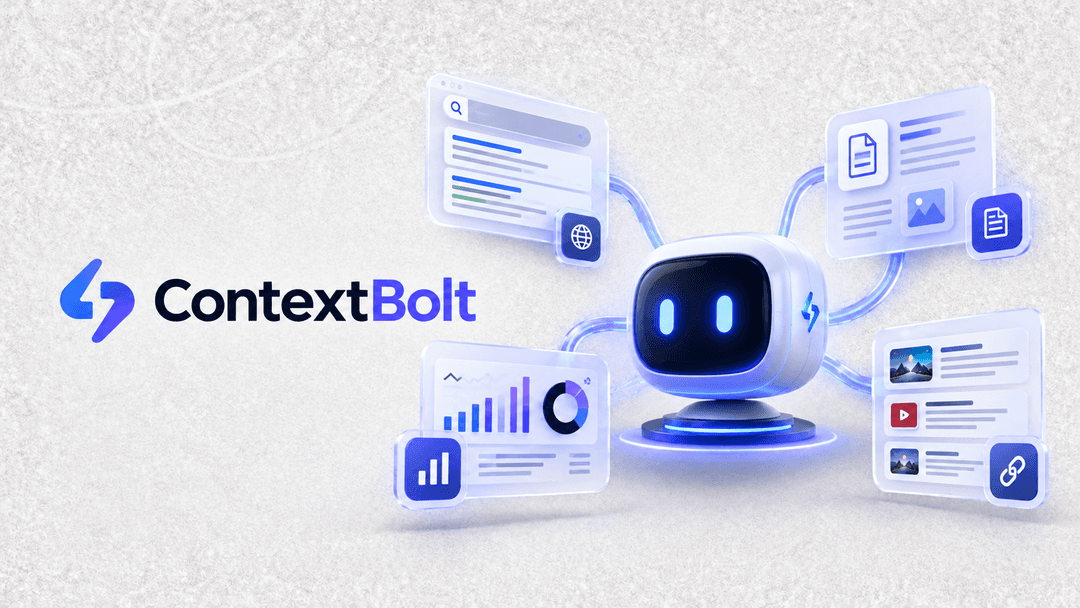
AI assistants are becoming increasingly capable, but there's still a fundamental problem: they don't always have access to the information we need them to work with. ContextBolt is building tools to help bridge that gap.
How many times have you saved an interesting post on LinkedIn or Reddit, thinking you might need it someday, only to spend ages trying to find it again?
Or perhaps you've asked ChatGPT or Claude to help you identify the best keywords for your website, only to receive suggestions that sound perfectly reasonable but aren't necessarily based on actual search data.
We've all been there.
The problem isn't necessarily that AI models aren't intelligent enough. In fact, they've become remarkably good at understanding questions, generating content and helping us work through complicated problems.
But even the most sophisticated AI model has a limitation.
It can't reliably use information it doesn't have access to.
And that's precisely the problem ContextBolt is trying to address.
Founded in 2026, ContextBolt is a small, independently developed technology project focused on connecting AI assistants with information that would otherwise remain outside their reach.
From saved social media posts to search engine data and competitor analysis, the idea is relatively straightforward: make the information people already use accessible to the AI tools they're increasingly relying on.
The problem isn't always the AI model
Over the past few years, we've become accustomed to treating AI assistants as tools that can answer practically anything.
Need help writing code? Ask Claude.
Want to understand a complicated concept? ChatGPT can probably explain it.
Looking for ideas for your next marketing campaign? There are dozens of AI tools willing to help.
But there's an important difference between a model's general knowledge and the information needed to complete a specific task.
Imagine you're running a small business and want to improve your website's visibility on Google.
You could ask an AI assistant to analyse your content and suggest opportunities for improvement.
It might recommend better headlines, more relevant keywords or changes to your website structure.
Some of those suggestions could be useful.
But without access to actual search volumes, keyword difficulty, competitor rankings and your website's performance data, much of the analysis will inevitably be based on assumptions.
The same problem exists with personal knowledge.
We spend years collecting information across different platforms. We bookmark articles, save tutorials, collect research and occasionally stumble upon something genuinely useful.
Then, when we need that information, we can't remember where we put it.
And unless we've explicitly connected those sources to our AI assistant, it can't find them either.
This is where the concept of context becomes important.
Rather than simply asking AI to generate an answer, what if we could give it access to the relevant information before it responds?
That's the thinking behind ContextBolt.
A small project built around practical problems
ContextBolt has a rather interesting origin story.
The company wasn't founded by a large team of engineers or backed by millions in venture capital.
According to its website, it was started by David, a founder with a background in SEO and marketing, who wanted to solve problems he encountered in his own work.
The project remains bootstrapped and operated by a single founder.
One frustration was the amount of useful content he had saved across social media platforms, with no convenient way to search and reuse it.
Another was having to move constantly between SEO platforms and AI assistants to access information that could have been available in the same conversation.
Rather than building another general-purpose AI application, David began developing tools that could connect existing AI assistants to those missing sources of information.
The result was two products: ContextBolt Bookmarks and ContextBolt SEO.
Both tackle different problems, but they share the same underlying idea.
Your AI assistant is already capable of doing quite a lot. Sometimes, it simply needs access to the right data.
ContextBolt Bookmarks: Making saved content useful again
Think about how much information you've saved online over the years.
Perhaps you're an entrepreneur researching startup ideas. You've collected dozens of posts about fundraising, customer acquisition and lessons from other founders.
Some are on X, others on Reddit or LinkedIn.
A few months later, you remember reading something particularly interesting about a marketing strategy.
Unfortunately, you can't remember who wrote it, where you saw it or what the original headline was.
You know you've saved it somewhere.
Good luck finding it.
This is the problem ContextBolt Bookmarks is designed to solve.
Available as a Chrome extension, it allows users to bring saved content from different sources into a searchable library.
The tool supports web pages, X, Reddit and LinkedIn, helping users organise the information they've collected rather than leaving it scattered across multiple platforms.
It also uses AI to categorise saved content, making it easier to navigate.
But the interesting part comes when that library is connected to an AI assistant.
Instead of manually searching through hundreds of bookmarks, users with the Pro plan can allow a compatible AI assistant to search their saved information.
For example, you could ask:
"Find the article I saved about bootstrapping a SaaS company."
Or:
"What were those marketing strategies I bookmarked a few weeks ago?"
The assistant can search the available library and retrieve relevant information.
For researchers, developers, marketers and anyone who regularly saves useful content, the idea has obvious appeal.
Rather than simply collecting information, you can potentially make better use of it.
ContextBolt Bookmarks is free for up to 150 saved items. A Pro subscription, currently priced at $6 per month, removes that limit and adds cloud synchronisation, export capabilities and AI integration.
It's a relatively simple concept.
But sometimes, the most useful technology solves problems we've become so accustomed to that we've stopped questioning them.
ContextBolt SEO: Bringing real search data into AI conversations
The company's second product addresses a different audience: website owners, marketers, developers and small businesses trying to improve their online visibility.
If you've ever worked on search engine optimisation, you'll know how much time can be spent switching between tools.
You might use one platform for keyword research, another to check competitors, Google Search Console to monitor performance and an AI assistant to help interpret the results.
Each tool has its purpose.
But getting them to work together isn't always particularly convenient.
ContextBolt SEO attempts to simplify that process by making SEO data accessible directly through compatible AI assistants.
Rather than switching between multiple dashboards, users can ask questions in natural language and retrieve information about keywords, search rankings, competitors, backlinks and website performance.
For example, imagine asking:
"Which keywords should I target for my next article?"
A general-purpose AI assistant might produce a list of suggestions based on its understanding of the subject.
With access to ContextBolt SEO, the assistant can also retrieve relevant keyword data, including search volumes and competition metrics, to help inform those recommendations.
Or perhaps you want to understand why a competitor consistently ranks above your website.
You could ask the assistant to investigate the search results, compare relevant information and identify areas worth exploring.
The platform also offers access to website auditing tools and Google Search Console data.
Another interesting feature is its focus on AI search visibility.
As people increasingly use AI-powered search experiences to discover products, services and information, businesses are beginning to pay attention to whether their brands appear in AI-generated answers.
ContextBolt SEO includes tools designed to help users explore this type of visibility across supported AI search experiences.
Of course, access to better data doesn't guarantee higher search rankings or more website traffic.
And AI-generated recommendations still need to be evaluated.
But having relevant data available within the same conversation can make the research process more convenient.
ContextBolt SEO currently costs $35 per month following a seven-day free trial, with usage managed through a credit-based system.
The technology behind it: What is MCP?
Both products are built around a technology that has been attracting increasing attention in the AI development community.
It's called Model Context Protocol, or MCP.
The name might sound complicated, but the underlying idea is relatively straightforward.
Imagine an AI assistant that can understand your instructions perfectly but has no access to the applications, databases or information sources you use every day.
You can ask it to analyse your website, but it can't see your analytics.
You can ask it to find a document, but it doesn't have access to your files.
You can ask it to investigate your competitors, but it can't retrieve the relevant information.
MCP provides a standardised way for AI applications to connect with external tools and data sources.
Instead of developing a completely different integration for every AI application, developers can expose capabilities through an MCP server that compatible clients can use.
For ContextBolt, this means making SEO data and saved content available inside tools such as Claude, Cursor and other MCP-compatible environments.
A developer working in Cursor could potentially access SEO information without leaving their development workflow.
A marketer using Claude could conduct keyword research through a conversation.
And someone using ContextBolt Bookmarks Pro could ask their assistant to retrieve information from their personal library.
The technology doesn't make AI infallible, of course.
Data can still be incomplete, outdated or misunderstood.
And connecting personal or business information to external tools introduces questions around permissions, privacy and security.
But it does address an important limitation of general-purpose AI assistants: their ability to access the information required to perform useful work.
Why this matters for smaller businesses
One of the more interesting aspects of ContextBolt is that its products aren't exclusively designed for large organisations.
In fact, smaller businesses and independent professionals may find some of these applications particularly relevant.
Consider a freelance marketer managing several clients.
They might spend considerable time researching keywords, analysing competitors and preparing content recommendations.
Or imagine an independent developer launching a new SaaS product.
They need to understand what potential customers are searching for, which competitors dominate relevant keywords and how their website is performing.
Then there's the content creator who saves hundreds of articles, tutorials and ideas across different platforms.
These users have different needs, but they share a common frustration.
Information is scattered across applications, and retrieving it often involves more work than it should.
ContextBolt's approach is to reduce some of that friction by connecting information sources to the AI tools people already use.
That doesn't mean everyone needs these products.
Someone who rarely saves online content probably doesn't need a dedicated AI-powered bookmark manager.
Similarly, a business with an established SEO workflow might already have the tools and integrations it requires.
But for users who frequently move between AI assistants and external sources of information, there's a clear use case worth exploring.
The value isn't necessarily in introducing another tool.
It's in making existing workflows a little less complicated.
A different approach to building AI products
There's another interesting aspect of ContextBolt's story.
While much of the technology industry is focused on developing increasingly powerful AI models, ContextBolt represents a different approach.
It isn't trying to build the next ChatGPT.
It isn't developing its own large language model or attempting to compete directly with the companies behind them.
Instead, it's building relatively specialised tools around the capabilities those models already have.
And that reflects a broader opportunity emerging within the AI ecosystem.
As the underlying models become more capable, there's growing room for products that help them interact with real-world information, applications and business processes.
Some will focus on software development.
Others will specialise in research, analytics, customer support or business automation.
The underlying AI model might be the same.
What changes is the information it can access and what users are able to accomplish with it.
For independent developers and smaller technology companies, that's an interesting opportunity.
Building a useful AI product doesn't necessarily require training a model from scratch.
Sometimes, identifying a relatively ordinary problem and connecting the right technologies is enough to create something people find valuable.
ContextBolt's two products are examples of that approach.
They're focused on specific use cases rather than attempting to solve everything.
And while it's still an early-stage project, the direction is worth watching.
The future of AI isn't just about smarter models
Over the past few years, much of the conversation around artificial intelligence has centred on the capabilities of the models themselves.
Which one is better at coding?
Which one produces more accurate answers?
Which one can handle more complicated reasoning tasks?
These are important questions, and improvements in the underlying technology continue to create new possibilities.
But as AI assistants become part of everyday workflows, another question is becoming increasingly relevant.
How do we make sure they have access to the information needed to do their jobs properly?
An AI assistant doesn't necessarily need to know everything.
Sometimes, it simply needs to know where to find the right information.
For a developer, that might mean accessing technical documentation or project files.
For a marketer, it could mean retrieving real search data.
For a researcher, it might involve searching through years of saved articles and references.
And for a business, it could mean connecting AI to the systems and knowledge its employees already rely on.
That's what makes projects like ContextBolt interesting.
Rather than trying to reinvent artificial intelligence, they're exploring ways to make existing AI tools more useful.
The technology behind these products may continue to evolve, and not every application will become an essential part of people's workflows.
But the underlying idea is difficult to ignore.
Perhaps the next major improvement in how we use AI won't come entirely from a more powerful model.
It might come from giving the models we already have better access to the information that matters.
For more information about ContextBolt and its products, visit contextbolt.com.
Follow Arageek on Google
Make Arageek your preferred source, so our news shows first in your search results.
Newsletter
Get the Arageek newsletter
Join more than 60,000 subscribers and get the AI and tech news that matters, straight to your inbox.
Free. Unsubscribe at any time. Read our privacy policy.