
Summary
- Egypt's ICT ministry is building the Riyadiya incubator for women-led startups.
- The first cycle targets agriculture, environment, handicrafts and local production.
- GUPCO and 18 local and international partners, including UNDP, support the programme.
- Registration is open in Greater Cairo, Upper Egypt and the Red Sea.
- A parallel Qudwa-Tech course with National Bank of Egypt trained 194 women.
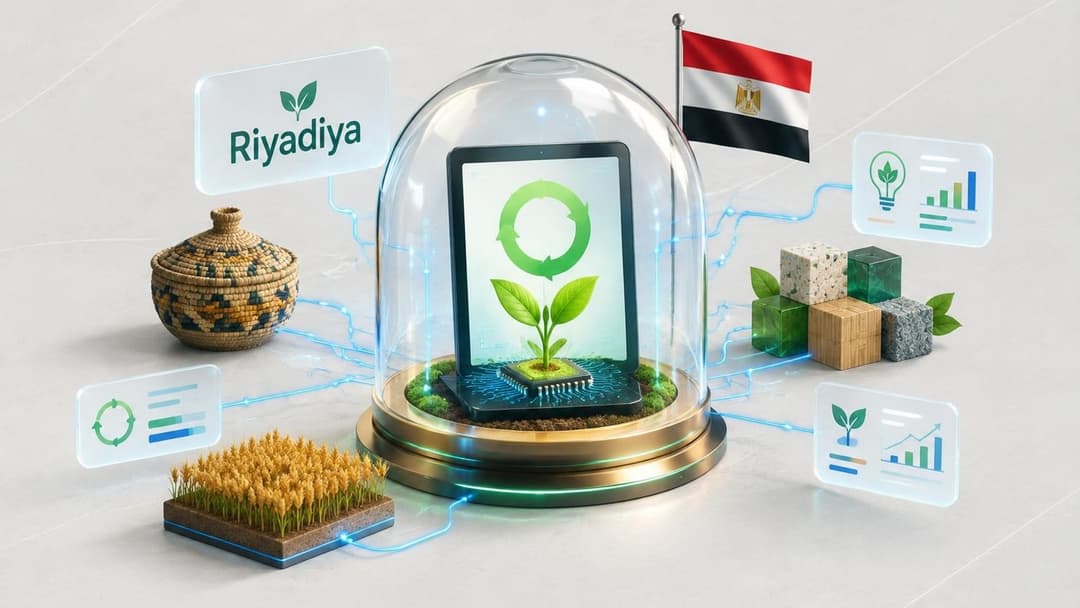
Egypt is widening the pipeline of startups working in the circular economy, and it is doing it by betting on women. The Ministry of Communications and Information Technology is building Riyadiya, an incubator that brings together women business owners and women technology specialists to develop digital solutions in agriculture, the environment, handicrafts and local production. The programme is being run with the Gulf of Suez Petroleum Company (GUPCO) and 18 local and international partners, according to entARABI.
The goal is simple enough on paper. Riyadiya wants to take projects from the idea stage to workable business models, and then all the way to founding startups led by women.
Along the way, participants get training, technical mentoring, introductions to investors and channels to reach the market. That last bit matters more than it sounds. Plenty of early founders can build a decent product; finding paying customers and the right backers is where many of them stall.
Why the circular economy? Put plainly, it is about using resources more efficiently, cutting waste, and reusing and recycling materials rather than simply producing, selling and throwing away. The ministry's choice signals a push to use technology on those problems, which opens room for new products, services and business models beyond traditional production and distribution.
The first cycle of Riyadiya focuses on digital solutions for agriculture, the environment, handicrafts and local production. The idea is to pair the hands-on experience of businesswomen with the skills of women tech specialists, so that teams start from a real market need and design a solution around it. To be fair, that pairing is spot on: some of the most useful startups come from people who have lived the problem teaming up with people who can code the fix.
The process runs in stages. It starts with recruiting participants and selecting ideas, moves on to training, capacity building, hackathons and hands-on activities, and then incubates the chosen projects with technical mentoring and links to investors and markets. That could mean apps and digital products that help businesses manage resources and production better, or make use of waste and reusable materials.
The partner list is broad. Alongside GUPCO, the 18 participating bodies include the United Nations Development Programme, the International Labour Organization, the National Council for Women and Banque du Caire, as well as universities and research institutions.
The ministry has opened registration for the first cycle to women business owners and women tech specialists in Greater Cairo, the Upper Egypt governorates and the Red Sea governorate. Spreading the net beyond the capital is a welcome touch, as good ideas are hardly limited to Cairo.
There is a second track running in parallel, focused on commercial and financial skills. Working with the National Bank of Egypt, the ministry delivered an online training programme under its Qudwa-Tech initiative, which benefited 194 women business owners and handicraft entrepreneurs. The training covered five areas, from marketing basics, the marketing mix and building relationships to project finance fundamentals, preparing and analysing financial statements, and developing a business model and handling legal incorporation.
Around Arageek, we often talk about how the gap for women founders in the region is less about ideas and more about access: to capital, to networks and to the nuts and bolts of running a company. I reckon pairing a hands-on incubator with practical finance training is a sensible way to tackle both sides at once. That said, the real test will come later, in how many Riyadiya teams actually incorporate, raise money and find customers. If the first cycle delivers even a handful of solid circular economy startups led by women, Egypt will have a useful model that others in the region could borrow.
🚀 Got exciting news to share?
If you're a startup founder, VC, or PR agency with big updates—funding rounds, product launches 📢, or company milestones 🎉 — AraGeek English wants to hear from you!
✉️ Send Us Your Story 👇