
Summary
- GlassPoint has raised $24M in a round led by a European asset manager.
- MITO Tech Ventures joined, taking the company's 2026 funding to $44M.
- The money will fund new operations in Saudi Arabia, Kuwait and Oman.
- GlassPoint builds and runs solar heat plants and sells heat on contracts of up to 20 years.
- Its Ma'aden Solar I project in Saudi Arabia will supply steam for alumina refining.
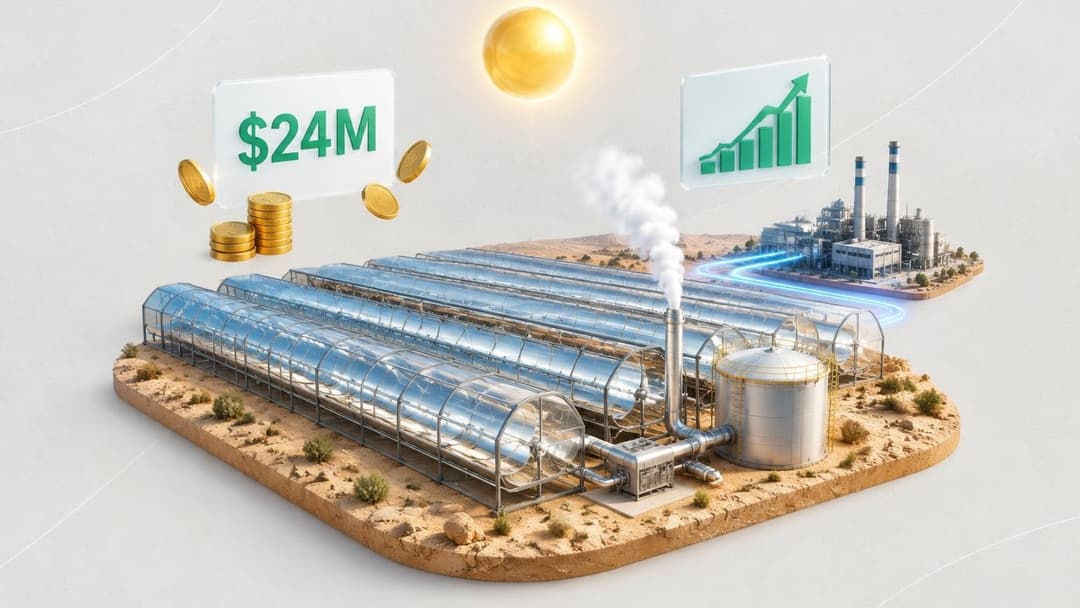
GlassPoint, the company that turns concentrated sunlight into heat for factories, has raised $24 million in a new investment led by European asset manager N.I.S. New Investment Solutions, with MITO Tech Ventures joining the round. The deal takes the money GlassPoint has raised during 2026 to $44 million.
The plan is squarely regional. GlassPoint will use the funds to set up operations in Saudi Arabia, Kuwait and Oman and to strengthen its presence in the UAE, where it moved its executive team from the United States and Europe earlier this year. It is also bringing in senior leaders and engineering and operations talent to deliver large industrial projects.
Here is the problem it is going after. Factories do not just need electricity; they need huge amounts of heat. Mining, metals, petrochemicals, oil and gas and building materials all rely on heat for steam, refining, heating and chemical reactions, and much of it still comes from burning natural gas and other fossil fuels. That ties running costs to fuel prices and supply, and it adds a hefty chunk of emissions.
GlassPoint's answer is to produce industrial heat directly from concentrated solar power, rather than turning sunlight into electricity and then back into heat. Curved mirrors inside enclosed systems focus the sun's rays to heat a fluid and generate steam. The company pairs this with thermal storage, including a system called Unify, so plants can keep receiving heat when the sun is not shining.
The business model matters just as much as the kit. GlassPoint finances, builds, owns and operates the solar thermal plants, while industrial customers buy the heat under long-term contracts of up to 20 years. In other words, a factory does not have to carry the full upfront cost of a thermal plant; it simply pays for heat as an operating service.
It is not starting from scratch in the Gulf, to be fair. Its Miraah project in Oman supplies solar steam for oil production at the Amal field, with a peak thermal capacity of 330 MW and output of around 2,000 tonnes of solar steam a day. It began operating in 2018.
The bigger bet is Ma'aden Solar I at Ras Al Khair in Saudi Arabia, developed with the Saudi Arabian Mining Company, Ma'aden. It is designed to supply steam for refining bauxite into alumina, a key input for aluminium. According to GlassPoint, the project targets 500 MW of continuous thermal capacity from a 1.5 GW thermal solar array, and once complete it is expected to produce up to 14,000 tonnes of steam a day, save around 12 million MMBtu of gas a year and avoid about 600,000 tonnes of carbon dioxide annually.
The timing lines up with the region's industrial push. Saudi Arabia is aiming for 36,000 factories by 2035 under Vision 2030, while the UAE's Operation 300bn strategy seeks to lift industry's contribution to GDP from AED 133 billion to AED 300 billion by 2031. More factories mean more demand for steady, lower-emission heat.
On the investor side, N.I.S. has now led both of GlassPoint's 2026 rounds. The company raised $20 million in January 2026, led by N.I.S. with existing investor MIG Capital taking part, before this latest $24 million round, which brings MITO Tech Ventures on board as a new backer.
That said, the hard part is still ahead. Moving from a proven technology to wide commercial roll-out needs serious project finance, long-term contracts with industrial customers and the ability to deliver on time and on budget. The economics will also depend on the temperatures each process needs, the price of the gas it replaces and how well storage covers nights and periods of weaker sunshine.
Around Arageek, we often talk about climate tech that actually fits the region's economy, and I reckon industrial heat is one of the quieter spots where the Gulf's sunshine and its heavy industry meet. If GlassPoint can turn its Oman and Saudi track record into signed contracts across Kuwait and the wider Gulf, this could be one of the more practical decarbonisation stories in MENA.
🚀 Got exciting news to share?
If you're a startup founder, VC, or PR agency with big updates—funding rounds, product launches 📢, or company milestones 🎉 — AraGeek English wants to hear from you!
✉️ Send Us Your Story 👇