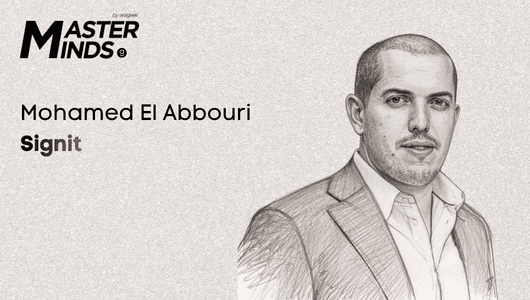
The layer he thought Saudi Arabia was missing
Saudi Arabia did not need another signing tool. That is Mohamed El Abbouri’s starting point, and it explains much of what Signit became.
When asked about the gap that led to the company, he does not describe a product opportunity so much as an infrastructure one. As organisations across the Kingdom digitised core processes, one part of the stack remained oddly unresolved: how agreements were created, signed and managed in a way that was actually trusted under local law. In his telling, this was not about adding another feature to an existing category. It was about building a missing layer.
That view shaped the company early. International platforms were not designed for Saudi realities: weak Arabic support, misalignment with local compliance, and data routinely leaving the Kingdom. White-labelled products offered little comfort because they still were not built around the needs of Saudi institutions. Local alternatives, he says, barely existed.
So Signit pursued the harder route. It sought the Trust Service Provider licence from the Digital Government Authority and built a stack designed to make signatures legally binding under Saudi law. El Abbouri’s conviction was blunt: if Saudi Arabia was building a digital economy at speed, the trust infrastructure under it had to be built locally too.
What outsiders still misunderstand about building for Saudi Arabia
When the conversation turns to what foreign companies get wrong, El Abbouri’s answer is less ideological than operational. The mistakes, in his view, come from misunderstanding how trust is actually established in Saudi systems.
Identity is the first example. In Saudi Arabia, he argues, trust cannot rest on a simple email link and a polished user flow. It is anchored in national identity infrastructure, particularly Nafath and other government-backed sources. If a platform is not built around those rails, it may be usable, but it will not be fully trusted. Signit integrated with Nafath from the beginning because, as he sees it, that is how identity works in the market.
The same logic applies to data residency. Local rules, including PDPL requirements, are not secondary compliance tasks to be solved later. In regulated sectors, they shape whether a company can sell at all. If data sits overseas, many customers will not proceed.
Then there is language, where El Abbouri makes a more pointed distinction. Arabic, he says, is not a localisation layer. It is part of the product itself. Mixed-language contracts, right-to-left and left-to-right rendering in the same paragraph, and the difference between legal Arabic and everyday Arabic all create design and usability problems that cannot be solved by translating an interface and calling it done.
The final point is the least glamorous and probably the most important. Saudi organisations run on specific systems and follow specific workflows. Ministries procure in one way, banks approve contracts in another, hospitals handle patient consent differently again. Those patterns do not map neatly to playbooks imported from the US or Europe. El Abbouri’s broader argument is that local markets are not won by surface adaptation. They are won by understanding the institutional machinery underneath.
Why he thinks signing is only 2 per cent of the problem
Pressed on Signit’s AI claims, El Abbouri draws a line between what is useful and what is merely fashionable.
His central point is that companies overestimate the act of signing because it is the visible moment in a contract’s life. In practice, he says, signing accounts for roughly 2 per cent of the cycle. The real operational burden sits before and after it: drafting, reviewing, negotiating, approving, then tracking obligations, renewals, liabilities and commercial performance once the agreement is live.
That is where he believes AI has created real value. Before signature, it can materially reduce the manual work involved in drafting agreements, reviewing long contracts, checking terms against internal playbooks and testing compliance against Saudi regulations. The gain is not that legal and procurement teams disappear. It is that human judgement is reserved for decisions that deserve it.
After signature, the case becomes more strategic. Organisations can finally track obligations across large contract portfolios, monitor renewal windows, identify poor supplier terms and understand where liabilities sit. El Abbouri’s argument is that many companies simply could not do this at scale before. AI has made contract management less of an archive and more of an operating system.
He is notably less impressed by the louder claims around autonomous agents negotiating and executing contracts without human oversight. That, he says, is where the hype has outrun reality. More importantly, it is not a direction he thinks companies should want. In contracting, the human should remain in control, with the system surfacing recommendations for approval rather than acting independently. For him, this is not caution masquerading as ambition. It is the product philosophy. “Trust is the product.”
How trust was won, one government customer at a time
On the question of earning credibility in a market dealing with sensitive agreements, El Abbouri is clear about the hardest part: landing the first government customer.
The problem was circular. Every serious conversation led to the same test, which other government entity had already implemented the product? Early on, the truthful answer was none. That is the trap in trust-heavy markets. Buyers want proof before they move, but the proof only exists after someone moves first.
Signit broke through via an on-premise implementation where the requirements were specific enough that, in effect, it was the only fit. The project mattered not simply because it generated revenue, but because it created evidence. Once that institution could be named, the next conversation changed. The burden of proof started to shift.
That pattern, El Abbouri suggests, defines the Saudi enterprise and government market more broadly. Trust compounds. A respected customer does more than validate the product. It shortens future sales cycles because credibility begins to travel on its own.
Today, he says, Signit serves more than 30 government entities. But his account of that progress is disciplined. He does not present it as a smooth rise. He presents it as the outcome of one early institution taking a chance on a local company, and that company understanding it had to deliver well enough for the trust to spread.
The moment the company became what it said it was
Asked to reflect on the most important milestone so far, El Abbouri does not reach for a funding round or a title. He goes to December 2024, when the Digital Government Authority granted Signit a comprehensive Trust Service Provider licence.
What mattered about that moment was not the symbolism alone. For two years, he says, customers had asked the same question: are you licensed? During that period, the company was building the underlying technology, infrastructure and security in anticipation of the day it could answer definitively.
When the approval arrived, the significance was institutional as much as commercial. Signit became, in his words, the only startup in Saudi Arabia licensed as a comprehensive TSP. The point was not that the regulator had merely approved a company. It was that a Saudi startup had been recognised as part of the country’s trust infrastructure.
There is a useful distinction in how he frames it. For two years, the company had been telling the market what it intended to be. After the licence, it no longer had to argue the point. It simply was.
Why e-signatures were never the destination
When asked what business decision worked better than the rest, El Abbouri returns to an early strategic call: treating e-signatures as an entry point, not an end state.
That decision sounds obvious in hindsight, but it is clearly one he regards as foundational. It affected what Signit built, who it hired and which customers it pursued. If signing was only a sliver of the process, then the bigger opportunity lay in the full contract lifecycle, from drafting and review through negotiation, approval, execution and post-signature management.
His explanation of the AI shift fits neatly into that broader thesis. Contract lifecycle management already improved efficiency before the recent AI wave. What changed now, he argues, is that software can take on parts of the human work inside the process, not just route the process more cleanly. Drafting language, reviewing terms, checking against playbooks, surfacing risk and extracting obligations all move the system closer to being an active participant rather than a passive workflow layer.
The distinction matters because it shows how he thinks about category design. Signit was not built to defend a narrow signature product. It was built around the idea that contracts are operational systems, and that the most valuable software will increasingly sit across the full lifespan of those agreements.
The failure he attributes to himself
When the conversation moves to failure, El Abbouri does not hide behind market timing or bad luck. He names hiring, specifically his repeated failure to hire the right Head of Marketing.
Three attempts did not work. He treats that not as an isolated recruiting issue, but as a leadership blind spot. Signit, he says, had strength in product, sales, infrastructure and regulation. Marketing was the function where his own instincts were weaker, and the hiring mistakes reflected that. If a chief executive does not understand a function well, he argues, he is unlikely to hire into it well either.
He is candid about the cost. For a company with more than 700 customers, he believes the brand should be louder than it is. Sales had to compensate. More importantly, three failed senior hires meant roughly three years of lost momentum.
What changed was not a new theory of marketing, but finally finding someone he trusted to lead it properly. He points to a recent marketing manager who ran the Series A announcement strongly enough that El Abbouri could step back and follow his direction. That, by his own account, was unfamiliar. The significance lies less in the announcement itself than in the fact that he was no longer forced to substitute for the function.
The relationships that made the company possible
On the best decision of his career, El Abbouri goes further back, to joining Misk Foundation as a Senior Advisor in its early phase.
He describes that period as an education in Saudi Arabia’s scale of ambition. Misk was building institutions, programmes, partnerships and major initiatives from scratch, and being close to that work gave him a direct view into how the country was changing. Just as importantly, it gave him relationships that later proved decisive.
Those relationships, he says, were what led him towards Signit. Trusted people kept pointing to the same unmet need around e-signatures in Saudi Arabia. At some point, enough credible signals accumulate that they stop sounding anecdotal and start looking like a market truth. In his account, that is what happened. Repeated conversations turned into conviction, then into a company.
It is a useful reminder that entrepreneurial judgement is rarely formed in isolation. Often it is built through proximity, pattern recognition and knowing which signals to take seriously.
The cost of moving too slowly when you already know
Pressed on the worst decision he has made, El Abbouri does not point to a dramatic strategic error. Instead he focuses on pace.
In several areas, he says, the company could see where the market was going but did not always move with the speed that insight required. The mistake was not choosing the wrong direction. It was failing to close the gap between conviction and execution quickly enough.
That kind of delay is easy to rationalise, particularly in a fast-growing company where many things appear to be working at once. El Abbouri’s view is harsher. Delay costs momentum. Sometimes it also costs the chance to define the category before others do.
He says this has changed how he leads. He now makes decisions faster, commits earlier when the signal is strong, and pushes harder on pace. It is one of the more useful lines in the interview because it resists the founder cliché that mistakes are always about bold bets gone wrong. Sometimes the more expensive error is caution after the answer is already visible.
What he hires for, and what he mistrusts
When asked what advice he would give to people building technology companies in Saudi Arabia, El Abbouri reduces it to one lesson: the company you build is a direct result of the people you hire.
That principle matters everywhere, but he believes it matters especially in Saudi Arabia because the market is moving quickly and strong talent can alter a company’s trajectory in a short period. His own hiring criteria are straightforward: competence, trust and ownership. People need to be genuinely good at their craft, consistent between words and actions, and willing to move without constant prompting.
The red flags are equally clear. He mistrusts people who oversell, people who fail to follow through, and people who wait passively for direction.
Perhaps the most revealing operational habit he mentions is staying personally involved in recruitment. For Signit’s first 50 hires, he was directly involved alongside the operations team. He is careful to explain that this was not about an inability to delegate. It was about recognising that early hiring decisions are culture decisions. In the first years, a company is not merely filling roles. It is deciding what kind of organisation it is becoming.
Across the interview, that line may be the cleanest expression of how El Abbouri operates. He talks often about trust as infrastructure, as product design and as institutional proof. But underneath all of it is a simpler belief: companies become what they repeatedly choose, in product, in timing and especially in people.
Follow Arageek on Google
Make Arageek your preferred source, so our news shows first in your search results.
Newsletter
Get the Arageek newsletter
Join more than 60,000 subscribers and get the AI and tech news that matters, straight to your inbox.
Free. Unsubscribe at any time. Read our privacy policy.