Summary
- Heard gives coding agents a voice, turning blockers, questions and test results into updates.
- It helps developers supervise multiple sessions without constantly reopening terminals or watching screens.
- Higher plans add voice replies, phone pairing and “session-aware” routing to the right agent.
- Parrot offers read-only spoken codebase queries, while dashboards show progress, blockers and reviews.
- Source code stays on the Mac, though some managed features send small snippets externally.
By turning progress, blockers, test results, and questions into spoken updates, Heard helps developers supervise multiple coding agents without continuously watching their terminals.
AI coding agents are changing the rhythm of software development.
A developer can assign an agent a feature, refactoring task, investigation, or testing job and allow it to work for several minutes—or much longer. Multiple agents can operate simultaneously across separate repositories and terminal sessions.
Yet this creates a new productivity problem.
Agents may be autonomous enough to continue working, but developers still feel compelled to check their screens. Is the migration waiting for approval? Did the tests fail? Has the agent encountered an architectural decision? Is the task finished and ready for review?
Constantly reopening terminal windows undermines one of the main benefits of delegation.
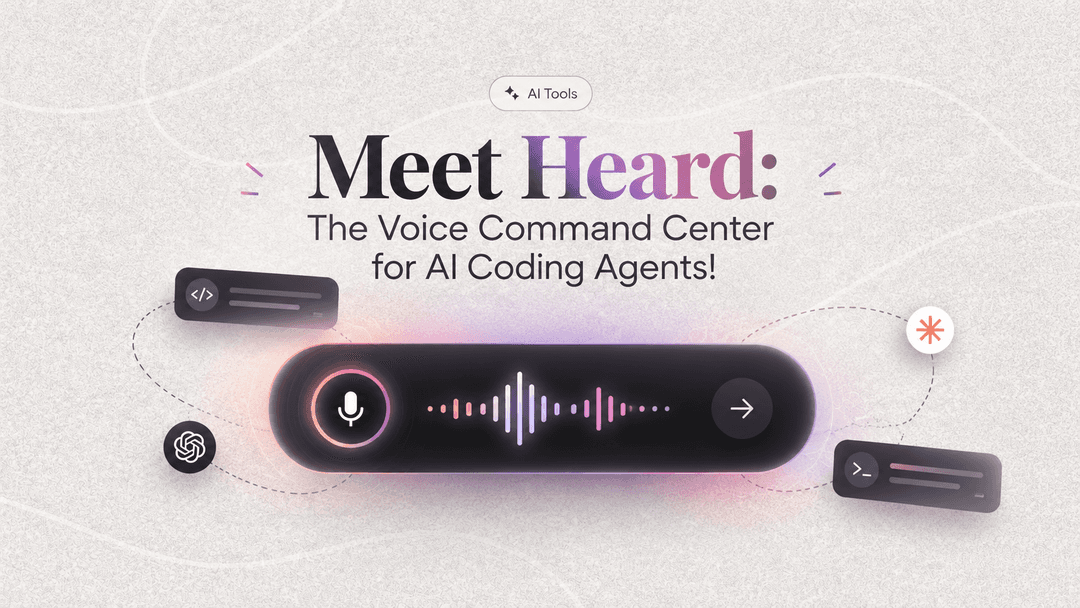
Heard addresses this problem by giving coding agents a voice. It monitors supported agent sessions, identifies meaningful developments, and converts them into spoken updates. On its higher-tier plan, developers can also respond by voice—even from a paired phone when they are away from the desk.
The product is not another coding agent. It is a communication and attention layer that sits between developers and the agents already doing the work.
From Screen Monitoring to Exception-Based Supervision
Traditional software tools generally assume that the user is looking at them.
Coding agents complicate this assumption because much of their work happens asynchronously. Watching an agent read files, execute commands, and reason through a task is rarely the best use of a developer’s time. Ignoring it entirely can be equally inefficient if the agent becomes blocked and waits for an answer.
Heard introduces a middle path: supervise by exception.
Instead of narrating every command and terminal line, the application can surface events such as:
- Meaningful progress
- Questions requiring a response
- Blockers
- Decisions awaiting approval
- Test results
- Errors and failed commands
- Completed tasks
- Work ready for review
A developer can continue writing, reviewing another project, making coffee, or walking around while listening for developments that actually require attention.
This changes the agent from something that must be watched into something that can call the developer when needed.
More Than Text-to-Speech for the Terminal
Reading raw terminal output aloud would quickly become overwhelming.
Coding agents produce large amounts of information: file paths, tool calls, diagnostic output, command results, explanations, and intermediate reasoning. Narrating everything would replace visual overload with audio overload.
Heard instead attempts to transform activity into concise operational summaries.
A useful spoken update might say that one agent finished refactoring authentication and passed 42 tests, while another is waiting for approval to run a database migration. That is more actionable than listening to every command that produced those outcomes.
Users can control how much information they hear. Heard presents different levels of narration, ranging from quick alerts to more detailed summaries. The objective is to match the amount of audio to the developer’s current situation.
Someone deeply focused on another task may want to hear only failures and questions. Someone walking away from the desk may prefer a fuller account of what changed.
Voice becomes a notification channel rather than a continuous transcript.
Built Around Multiple Agent Sessions
The value of this approach increases when a developer runs several agents at once.
Launching parallel tasks is easy. Keeping track of their individual states is harder.
One agent may be implementing a feature, another running tests, and a third reviewing a separate codebase. Each can finish, fail, or request input at a different time. The developer becomes responsible for polling several windows and remembering the context behind each one.
Heard keeps sessions distinct and identifies which project or agent produced each update. Its paid experience includes an “Agent View” and a “Mission Control” dashboard that presents active sessions, their status, recent progress, blockers, decisions, and results.
This gives developers two complementary ways to supervise work:
- Spoken updates for events requiring attention
- A visual overview for reviewing everything currently in motion
The combination is more practical than voice alone. Audio is effective at attracting attention, while a dashboard is better for comparing several sessions and inspecting details.
Heard’s broader argument is that developers need an attention queue for their agents—not simply more terminal tabs.
First-Class Support for Claude Code and Codex
Heard provides native integrations for Claude Code and Codex CLI. It can also observe Codex desktop sessions locally, according to the company’s documentation.
Native integrations receive structured events from the coding agent. That allows Heard to distinguish a question from a tool call or recognize that a task has completed, producing more reliable updates than simply parsing generic terminal text.
Other compatible command-line agents can operate through Heard’s universal wrapper, which launches the command and monitors its output. The wrapper expands compatibility, although it may provide less precise information than a dedicated integration.
The platform also works with supported terminal hosts such as Ghostty and cmux.
Compatibility is likely to remain an ongoing challenge. Coding agents evolve quickly, and event structures, hooks, session formats, and permission systems can change. Heard will need to maintain its adapters as the underlying products develop.
Talking Back to the Correct Agent
Listening is only half of the communication loop.
An agent may need the developer to choose between two implementations, approve an action, clarify a requirement, or provide another instruction. Returning to the computer and locating the correct terminal reintroduces friction.
The Heard Power plan adds two-way voice interaction. Developers can use push-to-talk on their Mac or a paired iPhone, and Heard routes the reply to the relevant agent session.
Session-aware routing is essential. When several agents are active, a response intended for the authentication task must not be delivered to the agent working on the website.
This creates a lightweight conversational operating model:
- The developer delegates a task.
- The agent works independently.
- Heard announces a material update or question.
- The developer responds by voice.
- Heard sends the reply to the corresponding session.
- The agent continues working.
This is not completely hands-free software development. Developers still need to inspect code, review diffs, validate tests, and make consequential decisions. It does, however, allow routine coordination to continue without requiring constant visual attention.
Taking Agent Work Away From the Desk
Heard Power can pair with an iPhone through the browser without requiring a separate phone application, according to the product website.
This lets a developer listen to updates and respond while moving away from the Mac. The computer continues running the coding agents, while the phone becomes a remote communication surface.
Potential situations include:
- Listening while walking around the office
- Receiving an update during a break
- Responding from another room
- Monitoring a long test or build process
- Staying informed during a commute as the Mac continues running safely elsewhere
Heard explicitly warns users not to build software while driving. Voice access reduces the need to look at a screen, but it does not make cognitively demanding technical decisions safe behind the wheel.
Remote interaction is most useful for status checks, straightforward clarifications, and low-risk approvals. Complex code review still belongs on a proper screen.
Making Codebases Conversational With Parrot
Heard also offers a feature called Parrot, which gives developers a spoken conversational interface for a codebase.
A user can ask questions such as:
- How does checkout move through the system?
- Where is authentication handled?
- Which components depend on this service?
- What changed while I was away?
- What remains uncommitted across my projects?
Parrot uses Claude Code or Codex installed on the same Mac to inspect the selected codebase. Heard says it creates a temporary headless worker for each question, meaning the coding agent does not need to remain open in a visible terminal.
Importantly, Parrot is designed as read-only. It can examine and explain code, but cannot edit files, execute commands, deploy changes, or modify connected systems.
This architectural limit reduces the risk of an informational question accidentally becoming an action.
Parrot should still be treated as a navigation aid rather than an authority. Its responses can help users locate architecture, ownership, data flows, and relevant implementation areas, but the source code, tests, documentation, and version history remain the evidence that developers must verify.
Accessibility Beyond Conventional Productivity
A voice layer may also make agent-based development more accessible.
Developers with dyslexia, visual fatigue, attention difficulties, migraines, repetitive-strain injuries, or other conditions may benefit from receiving information through audio rather than continuously reading terminals.
Even developers without a disability can experience fatigue after spending an entire day moving between code, logs, documentation, messaging applications, and browser tabs.
Heard does not replace a screen reader or specialized accessibility software. Its narrower role is to make coding-agent activity available through another sensory channel.
That choice can reduce screen dependence and allow developers to match the interface to the moment: text for detailed inspection, dashboards for comparison, and voice for awareness.
An Open-Source and Local Option
Heard offers two main operating paths.
The managed macOS application provides a guided installation, hosted narration services, managed voices, account synchronization, and the paid Pro and Power features.
The core Heard engine is also available under the Apache 2.0 license. Developers can build it from source, use their own provider keys, configure narration, or run the Kokoro text-to-speech model locally.
The open-source option is important for technically capable users who want greater control over processing and dependencies.
With local Kokoro speech and local narration templates, developers can keep voice synthesis on the Mac. Using external AI or speech services introduces additional data flows, whether through Heard’s managed service or the developer’s own provider account.
Open source does not automatically make software secure. Teams must still inspect the code, dependencies, configuration, updates, and permissions. But it makes the engine more transparent and provides an alternative to relying entirely on a hosted service.
Understanding What Leaves the Mac
Source code and agent transcripts are sensitive, so Heard’s privacy model deserves close attention.
According to its security documentation, source code, complete terminal output, and full agent transcripts remain on the Mac. When a managed feature requires external processing, a compact text snippet may pass through Heard’s hosted proxy to a language or speech provider.
Heard states that it does not persist:
- Source code
- Terminal output
- Agent transcripts
- Narration text
- Generated audio
- Hosted text rewrites
- Dictation-cleanup text
The company also says it does not sell private work or use agent sessions, code context, or voice interactions to train models.
Depending on the selected configuration, third-party providers may still process limited content. Heard identifies services including ElevenLabs and Speechify for speech synthesis, Anthropic or OpenAI for shaping narration, and Groq for optional dictation cleanup.
The managed service stores operational information such as account identifiers, subscription state, usage counters, device-token hashes, and billing-related records.
Organizations should distinguish between “not retained by Heard” and “never processed outside the device.” The fully local configuration provides the smallest hosted footprint, while managed voices and rewriting require selected content to cross the local boundary.
Teams handling highly confidential code should review the current privacy policy, provider terms, network flows, and internal security requirements before deployment.
Free, Pro, and Power Plans
Heard currently offers three individual tiers.
Free
The free plan includes the open-source, locally operated voice layer, support for multiple agent sessions, local Kokoro narration, bring-your-own-provider keys, and spoken updates for progress, blockers, and test results.
Pro
Pro costs $15 per month on monthly billing. It adds managed language and voice services, premium voices, synchronized session history, Agent View, Mission Control, daily summaries, and Dynamic Island-style progress updates on the Mac.
Power
Power costs $30 per month on monthly billing. It includes Pro features plus Turn View, phone pairing, push-to-talk, remote responses, and session-aware voice routing.
The website also advertises annual billing with a discount. Every managed-app download begins with a 14-day Power trial that does not require a payment card.
Heard currently focuses on macOS and iPhone-based workflows. Its public pages contain differing minimum macOS references—some mention macOS 13, while the homepage lists macOS 14—so users should confirm current compatibility before installing. Windows and Android support are described as future additions.
Pricing, platform support, and plan features may change, so readers should verify them on the official Heard website.
The Missing Interface for Autonomous Development
AI coding agents are becoming more capable, but the human interface around them is still immature.
Terminals were designed for direct interaction, not for supervising several autonomous sessions. Desktop notifications can announce completion, but they rarely communicate enough context. Dashboards provide visibility but still require the user to look.
Heard explores a different interface: agents speak when something meaningful changes, and developers answer when their judgment is required.
This does not remove humans from software development. It makes their involvement more selective.
Developers still own the architecture, requirements, review process, security decisions, and final result. But they no longer need to watch every intermediate step simply to discover whether an agent needs them.
As coding agents become more autonomous and parallel, the scarce resource may no longer be the ability to generate code. It may be the developer’s attention.
Heard is building for that future—one in which managing agents should feel less like monitoring a wall of terminals and more like leading a team that knows when to speak.