Summary
- UAE-based fintech Wafr has closed an undisclosed pre-seed funding round.
- Angel investors include Tyme Group co-founder Coen Jonker and ex-DBS innovation chief Neal Cross.
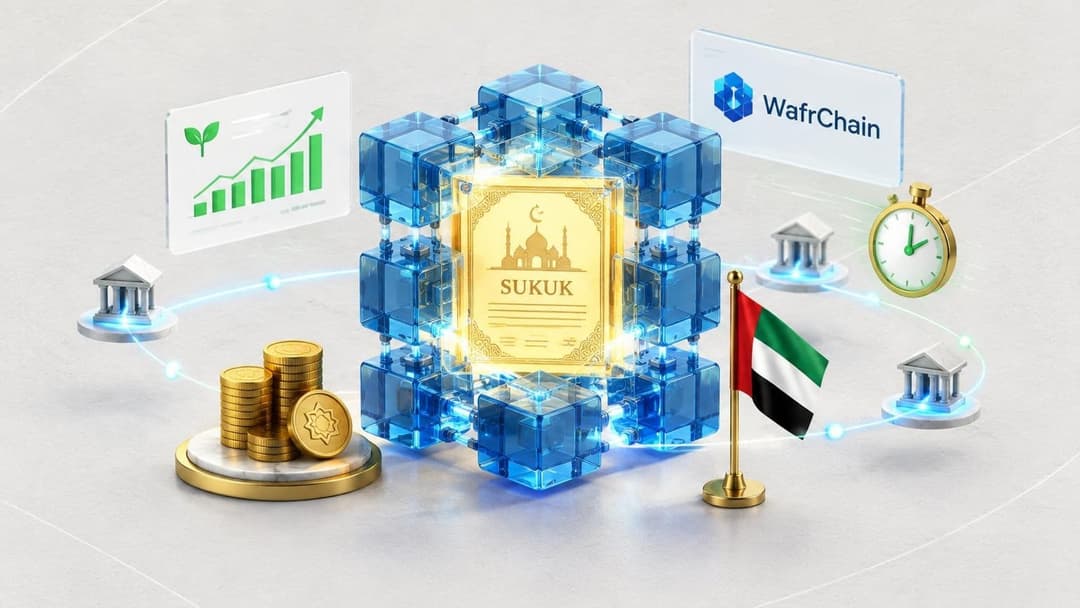
- Its first product, WafrChain, is a permissioned blockchain for sukuk issuance and settlement.
- Settlement can run in fiat currency or stablecoins, with Shariah approvals recorded on-chain.
- Plans include fund tokenisation, trade finance, remittances and cards, subject to regulatory approvals.
UAE-based fintech Wafr has secured an undisclosed pre-seed funding round from a group of individual investors, including Coen Jonker, co-founder of Tyme Group, and Neal Cross, former Chief Innovation Officer at DBS Bank. Alongside the raise, the company has launched WafrChain, its first product: a platform for on-chain, Shariah-compliant sukuk, with sukuk tokenisation now live.
Wafr was co-founded in 2026 by Chief Executive Officer Mahmoud Bouchelif and Chief Product Officer Anthony Murphy. Bouchelif is a former Islamic banker and the founder of LeanTech SG, which he built into a profitable business with 7-figure revenue without external funding. He has also advised GCC banking leaders on digital transformation for approximately a decade. Murphy, for his part, has launched digital banking products at AMP, Commonwealth Bank of Australia and Macquarie Bank.
The investor line-up carries some weight too. Jonker is a former Commonwealth Bank of Australia Group Executive, while Cross is also co-founder of PictureWealth.
So what problem is Wafr going after? Sukuk remain one of the most complex instruments in Islamic finance to bring to market. A single issuance typically involves eight separate parties, from the issuer, trustee and arrangers to the Shariah board, custodians, paying agent, distributors and investors, each keeping its own record of the same instrument. Every transfer, profit payment and corporate action is re-keyed and reconciled between them. Frankly, it sounds like a bit of a faff, and the company says an issuance can take many months, in some cases more than a year, to reach the market.
WafrChain is a private, permissioned blockchain that connects those institutions through one shared record. Instrument terms, including unit price, profit schedule and maturity, sit on-chain alongside the approval of the issuer's own Shariah board before distribution, while Wafr's Shariah board works with each issuer to confirm the structure is compliant. Smart contracts route profit payments, and settlement can happen in fiat currency, through local real-time gross settlement systems and SWIFT, or in stablecoins. Institutions plug in through a single API.
Speed and privacy are central to the pitch. Transactions reach finality in 300 milliseconds, each participant sees only its own activity, and the network is designed to keep running with only a third of its nodes active.
"Islamic finance can bring abundance to people, businesses and economies, yet access to services that reflect its principles remains uneven. We are building Wafr for everyone who believes finance should be fair, transparent and ethical, whatever their faith."
That was Bouchelif, who described WafrChain as the starting point for giving institutions a foundation to bring Shariah-compliant assets on-chain. Murphy said the team starts "with the problems people and businesses are actually facing", calling WafrChain "the first product built with that thinking".
The investors sound just as convinced. Jonker said he has "long believed that someone will build a truly global digital finance business for the Muslim world", while Cross noted that Wafr is "one of the few teams starting with the customers who need it most", adding that backing the founders "was an easy decision".
The market is certainly big enough. According to the ICD–LSEG Islamic Finance Development Report 2026, global Islamic finance assets reached $6.5 trillion in 2025, up 9% year on year. Sukuk outstanding stood at $1.14 trillion, while annual issuance rose 14.5% to $291.4 billion. Beyond sukuk, Wafr's roadmap covers fund tokenisation, tokenised deposits, trade finance and business-to-business settlement, plus consumer plans for global accounts, cross-border remittances and cards. Those consumer services will be introduced in line with the applicable regulatory processes and approvals, working with licensed partners where required.
Around Arageek, we often talk about how Islamic finance has been slow to get the digital treatment it deserves. I reckon Wafr's choice to start with the plumbing, rather than a shiny consumer app, is spot on. That said, it's early days: the real test will be persuading issuers, arrangers and custodians to share one ledger. If it does, the region's sukuk market could look rather different in a few years.
🚀 Got exciting news to share?
If you're a startup founder, VC, or PR agency with big updates—funding rounds, product launches 📢, or company milestones 🎉 — AraGeek English wants to hear from you!
✉️ Send Us Your Story 👇