
Nvidia at a glance
Much of the world’s AI runs on Nvidia hardware. Fortune estimates that the company holds about 80% of the global AI chip market, and Microsoft Azure, Google Cloud and Oracle were among the first users of its newest system, Vera Rubin NVL72.
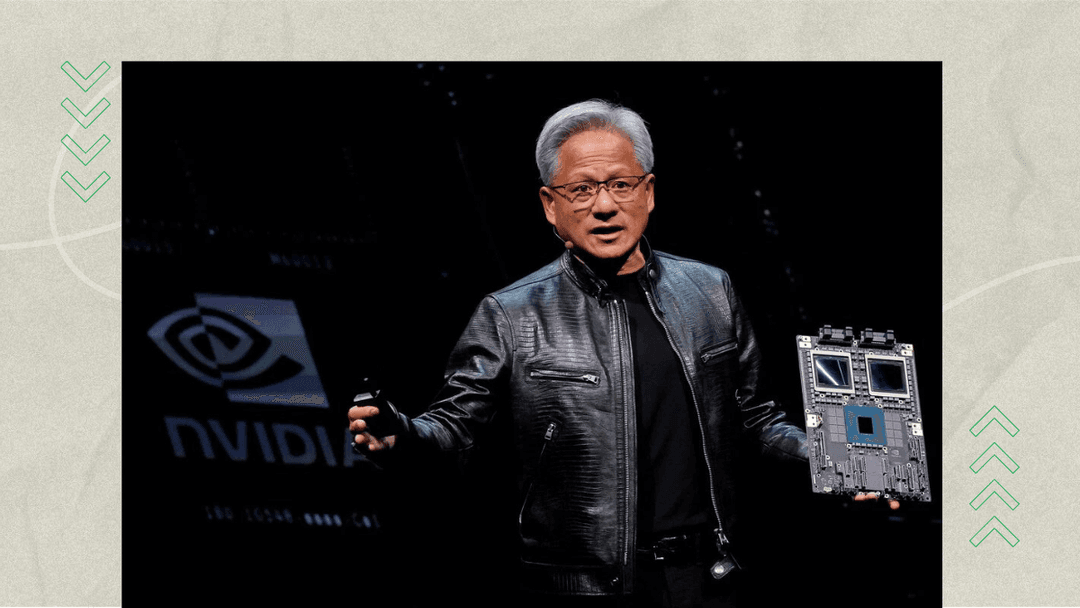
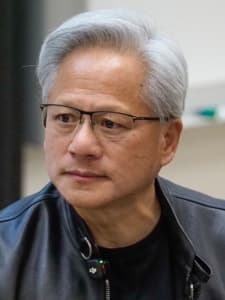
NVIDIA Corporation designs graphics processors (GPUs), AI chips and networking equipment and has other companies manufacture them. Jensen Huang, Chris Malachowsky and Curtis Priem founded it in California in April 1993, and it has been listed on Nasdaq since January 1999. Based in Santa Clara, California, it had about 42,000 employees in 38 countries in early 2026 and revenue of $215.9 billion in fiscal 2026.
Huang runs the company as president and chief executive. Harvey C. Jones has chaired the board since November 2026, and Colette Kress has been chief financial officer since 2013. In 2025 it signed deals with OpenAI, Anthropic and Saudi Arabia’s HUMAIN.
- Revenue
- $215.9 billion Fiscal 2026 (to 25 January 2026)
- Net income
- $120.1 billion Fiscal 2026 (to 25 January 2026)
- Data Center revenue
- $193.7 billion Fiscal 2026 (to 25 January 2026)
- Employees
- About 42,000 End of fiscal 2026
Key moments
- 1993Jensen Huang, Chris Malachowsky and Curtis Priem found Nvidia in California.
- 1995The first product, NV1, comes out, and its sales soon fall sharply.
- 1997The RIVA 128 sells a million units in four months.
- 1999Nasdaq IPO at $12 a share, and the launch of the GeForce 256.
- 2000Agreement with Microsoft to supply the Xbox graphics chips.
- 2001Purchase of the assets of 3dfx for about $70 million.
- 2006CUDA opens GPUs to general-purpose computing.
- 2012The AlexNet neural network runs on Nvidia GPUs.
- 2018RTX brings real-time ray tracing.
- 2020The $7 billion Mellanox deal closes, and the Arm bid is announced.
- 2022The Arm deal is dropped, and the US limits sales of top AI chips to China.
- 2023Market value reaches $1 trillion for the first time.
- 2024Nvidia replaces Intel in the Dow Jones Industrial Average.
- 2025First company to close above $5 trillion, and a partnership with HUMAIN in Saudi Arabia.
- 2026Fiscal 2026 revenue of $215.9 billion, the Vera Rubin launch and an agreement to buy Hugging Face.
History of Nvidia
1993: three engineers and a Denny’s booth
Nvidia was incorporated in California on 5 April 1993. Its founders were Jensen Huang, who had worked at AMD and then LSI Logic, and Chris Malachowsky and Curtis Priem, who both came from Sun Microsystems. They planned the company in a booth at a Denny’s restaurant, a chain where Huang has said he once washed dishes and waited tables, and on 26 September 2023 Denny’s put a plaque on the booth. According to Fortune, the three later moved their meetings to Priem’s townhouse after noticing bullet holes in the restaurant’s front window.
Huang suggested the name Nvidia, from invidia, the Latin word for envy. Sequoia Capital has backed the company since 1993, after Wilf Corrigan, the head of LSI Logic, sent Huang to Sequoia’s Don Valentine.
1995 to 1998: a failed first chip and a lifeline from Sega
Nvidia’s first product, the NV1, came out in May 1995. It was a multimedia accelerator for 3D graphics, video and audio, aimed mainly at game consoles. Then the PC industry settled on Microsoft’s Direct3D and SGI’s OpenGL, and NV1 sales fell sharply. Huang says 249,000 of the 250,000 units shipped to Diamond Multimedia “came back.”
Nvidia also had a contract to design a console chip for Sega. It asked Sega to release it from the deal and pay anyway, and Sega paid “some 5 million dollars,” all the money Nvidia had left. Huang laid off nearly half the staff in 1996. The RIVA 128 followed in 1997 and sold a million units in its first four months.
1999 to 2001: Nasdaq, GeForce and the Xbox
Nvidia went public on Nasdaq in January 1999 under the ticker NVDA, selling 3.5 million shares at $12 each. Later that year it released the GeForce 256, which it presented as the world’s first graphics processing unit, or GPU. On 5 March 2000 it agreed with Microsoft to supply the graphics chips for the Xbox, and on 18 April 2001 it completed the purchase of its rival 3dfx’s assets for about $70 million in cash.
2006 to 2022: from games to AI
In 2006 Nvidia introduced CUDA, which let scientists and researchers use GPUs for parallel computing. Six years later its GPUs powered AlexNet, the neural network Nvidia credits with starting the modern AI era. The company’s market value first reached $100 billion in July 2017, and on 27 April 2020 it completed its $7 billion purchase of the networking company Mellanox.
A bigger deal fell through. In September 2020 Nvidia agreed to buy Arm for $40 billion, the US Federal Trade Commission sued to block it in December 2021, and Nvidia dropped the deal in February 2022. SoftBank and Arm kept the $2 billion paid at signing.
2023 to 2025: the trillion-dollar years
As demand for AI computing took off, data-center chips became most of what Nvidia sells. Its market value hit $1 trillion at the opening bell on 30 May 2023, after an earnings beat. On 8 November 2024 it replaced Intel in the Dow Jones Industrial Average, and on 29 October 2025 it became the first company to close above $5 trillion in market value.
It also put money into partners and customers. In September 2025 it agreed to invest $5 billion in Intel stock and signed a letter of intent with OpenAI to supply at least 10 gigawatts of Nvidia systems, investing up to $100 billion as they are deployed. In November it committed up to $10 billion to Anthropic, and on 24 December 2025 it took a non-exclusive license to the technology of the chip startup Groq, whose founder Jonathan Ross moved to Nvidia.
2026: Vera Rubin and a change at the top
Fiscal 2026 ended on 25 January 2026 with revenue of $215.9 billion, up 65%. At the GTC conference on 16 March, Huang launched the Vera Rubin platform and said he saw “at least $1 trillion in revenue from 2025 through 2027.” On 2 September Nvidia agreed to buy Hugging Face for about $11.9 billion, and on 6 October the stock closed at a record $239.24, when the company was worth more than $5.7 trillion. Third-quarter revenue, reported on 17 November, was $115.8 billion, more than double the year before.
November also brought two changes of chief executive in 11 days. On 8 November the board opened an independent investigation, after a New York Times report about Megaspeed, a Singapore-based Nvidia customer, and whether Nvidia chips had reached China through it. The board said it had “no reason to believe that either national security or NVIDIA secrets were compromised.” On 11 November it accepted Huang’s resignation: chief financial officer Colette Kress became interim CEO, and director Harvey C. Jones became the company’s first board chair. On 22 November the board unanimously reinstated Huang, saying that input from senior US government officials showed his return posed no national-security risk, and kept the investigation open.
Nvidia products and services
Nvidia reports two segments. Compute & Networking, which covers data centers, AI software and automotive, brought in $193.5 billion in fiscal 2026, and Graphics, which covers GeForce gaming GPUs and RTX workstation GPUs, brought in $22.5 billion.
Data-center chips
Data Center revenue was $193.7 billion in fiscal 2026, about 90% of the total and up 68%. Nvidia sells GPUs for training and running AI models, data-center CPUs such as Grace and Vera, and rack-scale systems built from them. The newest, Vera Rubin NVL72, is in Nvidia’s words “the fastest product ramp in company history,” and Google Cloud, Microsoft Azure and Oracle were among its first users. Its networking line includes NVLink interconnects and InfiniBand and Ethernet platforms. The next architecture is called Feynman.
Software
CUDA, launched in 2006, is the base for the CUDA-X libraries, NVIDIA AI Enterprise and Omniverse, a platform for 3D simulation and digital twins. The Hugging Face purchase is expected to close in the first half of 2027.
Gaming and PCs
Nvidia has sold GeForce cards since 1999. The current range is the GeForce RTX 50 Series, built on Blackwell, and the company also runs the GeForce NOW cloud gaming service. Gaming revenue was $16.0 billion in fiscal 2026, up 41%.
Cars and robots
For carmakers Nvidia sells DRIVE Hyperion, DRIVE AGX and DRIVE OS. In March 2026 BYD, Hyundai, Nissan and Geely joined its robotaxi platform, with Uber as a deployment partner. Automotive revenue was $2.3 billion in fiscal 2026, up 39%.
Key Nvidia products since 1995
| Product | What it is | Year |
|---|---|---|
| NV1 | First product, a multimedia accelerator | 1995 |
| RIVA 128 | Graphics chip | 1997 |
| GeForce 256 | Billed by Nvidia as the first GPU | 1999 |
| Xbox graphics chip | Graphics for Microsoft’s console | Agreement in 2000 |
| CUDA | Platform for programming GPUs | 2006 |
| RTX | Real-time ray tracing | 2018 |
| Omniverse | 3D simulation and digital twins | 2022 |
| Grace | Data-center CPU | 2023 |
| Blackwell | Data-center GPUs, also behind GeForce RTX 50 | Fiscal 2025 |
| Vera Rubin | Data-center platform of seven chips | 2026 |
Nvidia headquarters and sites
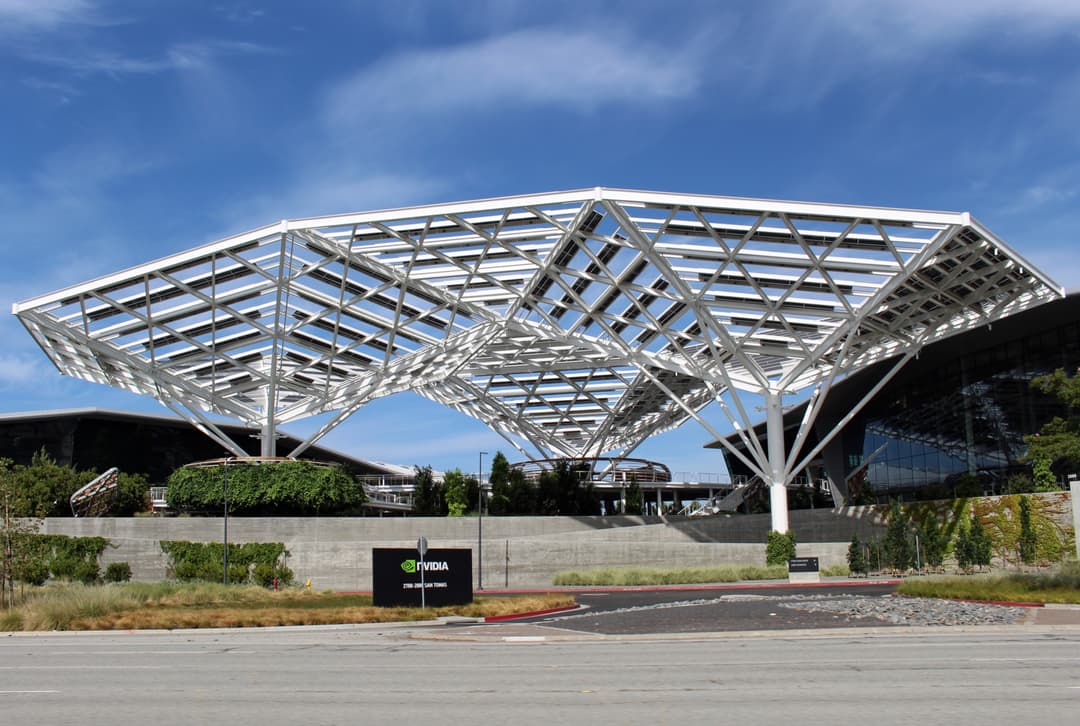
Nvidia’s headquarters is on San Tomas Expressway in Santa Clara, California, in two buildings designed by Gensler: Endeavor, finished in 2017, and Voyager, finished in 2022. VentureBeat put their combined cost at about $920 million. Nvidia has no factories of its own; third parties outside the United States make and package its chips. It had about 42,000 employees in 38 countries at the end of fiscal 2026.
| Site | Location | What is there |
|---|---|---|
| Headquarters | Santa Clara, California | Endeavor (2017) and Voyager (2022) |
| Israel sites | Israel | About 6,000 employees, mainly in networking R&D, and a campus in Kiryat Tivon for more than 10,000 staff, due to open in 2031 |
| Blackwell production | Phoenix, Arizona | At TSMC since 2025, part of a plan announced in April 2025 to produce up to $500 billion of AI infrastructure in the US |
| Supercomputer plants | Houston and Dallas, Texas | Built by Foxconn and Wistron under the same plan |
| PORTS-Pike campus | Ohio | AI computing for OpenAI from 2028, under a lease whose value Nvidia guarantees up to $105 billion |
| Other main sites | China, India, Taiwan | Named in the annual report |
Who owns Nvidia and who runs it?
Nvidia is a public company, listed on Nasdaq under NVDA since January 1999. According to its 2026 proxy statement, the largest holders on 23 March 2026 were BlackRock with 7.43% and Vanguard with 7.31%. Jensen Huang held 3.58%, a stake worth about $131 billion at the 27 November 2026 close.
Huang is president and chief executive, and he held those titles when the company went public in 1999. Harvey C. Jones has chaired the board since 11 November 2026, the first person in Nvidia’s history to hold the post. He has been a director since 1993 and is a former CEO of Synopsys. Colette Kress has been chief financial officer since September 2013 and was interim CEO from 11 to 22 November 2026. Nicholas Parker, who spent 26 years at Microsoft, took over worldwide field operations in August 2026 from Jay Puri.
Nvidia in numbers
| Period | Revenue | Net income | Diluted EPS |
|---|---|---|---|
| Fiscal 2024 (to 28 January 2024) | 60.9 | 29.8 | 1.19 |
| Fiscal 2025 (to 26 January 2025) | 130.5 | 72.9 | 2.94 |
| Fiscal 2026 (to 25 January 2026) | 215.9 | 120.1 | 4.90 |
| Q3 fiscal 2027 (to 25 October 2026) | 115.8 | 65.3 | 2.70 |
Source: Nvidia’s annual report for fiscal 2026, filed with the US Securities and Exchange Commission, and its third-quarter fiscal 2027 results of 17 November 2026. Revenue and net income are in billions of dollars, earnings per share in dollars. Nvidia’s fiscal year ends on the last Sunday of January. Its market value rose from $364 billion at the end of 2022 to $4.64 trillion at the end of 2025.
Nvidia in the Arab world
On 13 May 2025, during President Donald Trump’s visit to Riyadh, HUMAIN, the AI company of Saudi Arabia’s Public Investment Fund, announced AI factories of up to 500 megawatts built with Nvidia, using several hundred thousand Nvidia GPUs over five years and starting with a supercomputer of 18,000 GB300 chips. The Saudi Data and AI Authority (SDAIA) said the same day it would deploy up to 5,000 Blackwell GPUs. HUMAIN expanded the deal on 22 October 2026 with a plan for up to 84 megawatts and about 27,000 GPUs, starting in the fourth quarter of 2026. It is chaired by Crown Prince Mohammed bin Salman and run by its chief executive, Tareq Amin.
On 19 November 2025 the US authorized HUMAIN and the UAE’s G42 to buy the equivalent of up to 35,000 GB300 chips each, under strict security conditions. In the UAE, Nvidia is a technology partner in Stargate UAE, announced on 22 May 2025, a 1-gigawatt cluster in Abu Dhabi led by OpenAI with G42 that uses Nvidia GB300 chips. On 22 September 2025 Abu Dhabi’s Technology Innovation Institute, the developer of the Falcon models, opened a joint AI and robotics lab with Nvidia, the first NVIDIA AI Technology Center lab in the Middle East. Nvidia is also a founding member of the AI Infrastructure Partnership with Abu Dhabi’s MGX, and the Kuwait Investment Authority is one of its anchor investors.
In Qatar, Ooredoo signed a deal with Nvidia on 19 June 2024 that gives its data-center customers in Qatar, Algeria, Tunisia, Oman and Kuwait access to Nvidia’s AI platform, and on 1 July 2025 it launched a sovereign AI cloud in Qatar on Nvidia GPUs.
Criticism and challenges
Fortune estimates Nvidia’s share of the global AI chip market at about 80%. Rivals are growing: AMD reported Data Center revenue of $8.5 billion in the quarter to 26 September 2026, up 97%, against Nvidia’s $107.6 billion in the quarter to 25 October, and Broadcom, which designs custom AI chips, reported AI semiconductor revenue up 221% in its quarter to 2 August 2026.
US export controls have limited Nvidia’s business in China since 2022. A license requirement on H20 chips in April 2025 led to a $4.5 billion charge. In December 2025 Trump allowed H200 sales to approved Chinese customers, but Nvidia had booked no H200 revenue by its annual report and described itself as “effectively foreclosed” from China’s data-center compute market. On 15 September 2025 China’s market regulator said in a preliminary finding that Nvidia had broken the anti-monopoly law over the conditions of its Mellanox approval, and Nvidia said, “We comply with the law in all respects.”
On 6 May 2022 Nvidia paid a $5.5 million penalty to the SEC, which said the company had not disclosed that crypto mining drove much of its gaming revenue growth in fiscal 2018. Nvidia settled without admitting or denying the findings. An investor class action over the same period continues, and a class was certified on 25 March 2026.
Several inquiries remain open after the November 2026 events: the board’s independent investigation, a California Department of Justice probe, and an SEC look at Nvidia’s accounting reported by Reuters. On 17 November the Justice and Commerce departments announced an investigation into Megaspeed, which denies wrongdoing; Nvidia had said it found no evidence of illicit transfers. Huang is due to give a closed-door interview to House committees on 1 December 2026.
Facts about Nvidia
- The founders’ first choice of name was NVision. They dropped it because a toilet-paper maker already used it.
- Curtis Priem has said the founders wanted rivals to be “green with envy,” which is where the company’s green color comes from.
- Nvidia replaced Intel in the Dow Jones Industrial Average in November 2024, and ten months later it agreed to invest $5 billion in Intel.
- $100 invested in Nvidia stock on 31 January 2021 was worth $1,448.75 on 25 January 2026, against $200.33 for the S&P 500.
- Two customers alone made up 36% of Nvidia’s revenue in fiscal 2026.
Frequently asked questions about Nvidia
Who founded Nvidia?
Jensen Huang, Chris Malachowsky and Curtis Priem founded Nvidia in California on 5 April 1993. Huang had worked at AMD and LSI Logic, and Malachowsky and Priem came from Sun Microsystems. Huang is the company's chief executive today.
Who owns Nvidia?
Nvidia is a public company owned by its shareholders, and its stock trades on Nasdaq as NVDA. In March 2026 the largest holders were BlackRock with 7.43% and Vanguard with 7.31%, and co-founder Jensen Huang owned about 3.58%.
Where is Nvidia's headquarters?
At 2788 San Tomas Expressway in Santa Clara, California, where its two main buildings were finished in 2017 and 2022. Its other main sites are in China, India, Israel and Taiwan.
What does the name Nvidia mean?
It comes from invidia, the Latin word for envy, and co-founder Curtis Priem has said the idea was to make rivals "green with envy." The company pronounces its name "en-VID-eeyah."
Is Nvidia in Saudi Arabia and the UAE?
Yes, through partnerships. In Saudi Arabia, HUMAIN, part of the Public Investment Fund, has been building AI data centers with Nvidia chips since May 2025. In the UAE, Nvidia is a technology partner in Stargate UAE in Abu Dhabi and has run a joint lab with the Technology Innovation Institute since September 2025.
What is Nvidia's market value?
About $3.63 trillion at the close on 27 November 2026, at $150.49 a share. Its record close was $239.24 on 6 October 2026, when it was worth more than $5.7 trillion. The value changes with every trading session, and the latest close is in the stock box on this page.
What are Nvidia's main products?
Data-center chips and systems, the newest being the Vera Rubin platform, which made up about 90% of revenue in fiscal 2026. Nvidia also sells GeForce gaming GPUs, networking equipment, the CUDA software platform and DRIVE systems for cars.
Who is Nvidia's CEO?
Jensen Huang, one of its three co-founders, who was already chief executive when the company went public in 1999. He resigned on 11 November 2026 and the board reinstated him on 22 November. Chief financial officer Colette Kress was interim CEO in between.
Sources
- Nvidia annual report (10-K) for fiscal 2026, US Securities and Exchange Commission
- Nvidia third-quarter fiscal 2027 results (17 November 2026)
- Nvidia IPO prospectus (January 1999)
- Nvidia 2026 proxy statement
- Nvidia filing on the CEO transition (12 November 2026)
- Nvidia statement on Jensen Huang's return (23 November 2026)
- Nvidia corporate timeline
- Sequoia Capital: Crucible Moments, the Nvidia episode
- Fortune: where the name Nvidia comes from (2024)
- Nvidia and HUMAIN: AI factories in Saudi Arabia (May 2025)
- The National: HUMAIN expands its Nvidia deal (October 2026)
- CNBC: how Nvidia became the first $5 trillion company (2025)
- SEC: penalty over Nvidia's crypto-mining disclosures (2022)
- CompaniesMarketCap: Nvidia market capitalization