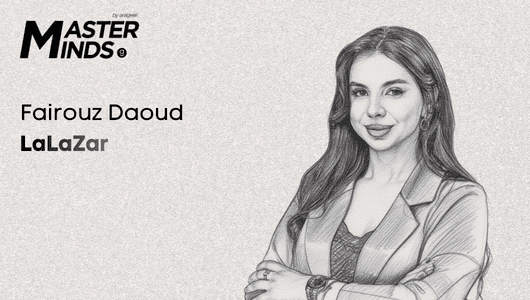
Fairouz Daoud is not interested in digital retail as a prettier catalogue. Her case for immersive commerce starts from a harsher diagnosis: online shopping in MENA has been functional, but emotionally thin. Consumers have demand, mobile habits and appetite for discovery. What they have not had, she argues, is a digital experience that offers confidence, context or any real sense of presence.
That is the gap she set out to address with LaLaZar. Her view is simple enough to sound obvious once stated: shoppers were not rejecting ecommerce, they were rejecting "uninspired online shopping". Static pages and generic product listings left brands fighting on discounts, while customers were left without the cues that help them decide in physical retail. For Daoud, immersive commerce was less about novelty than restoration. It was a way to bring back storytelling, intuition and something close to hospitality in a regional market that responds strongly to all three.
Why she thought MENA retail needed more than better product pages
When asked about the problem she most wanted to solve, Daoud returns to the mismatch between customer expectations and what brands were actually offering online.
She describes MENA as a market with strong retail demand and a young, experience-led consumer base, yet one still served by flat digital journeys. In her reading, the consequences were commercial as much as creative: low conversion, high returns and little room for distinction beyond price. Immersive commerce, in that context, was not an indulgence. It was a way for brands to recreate the decision-making logic of physical shopping in a digital format.
That regional point matters to her. She believes consumers in MENA place particular value on warmth, discovery and brand storytelling, and that digital retail has lagged behind those expectations. LaLaZar, then, was built around an ambition that is more operational than theatrical: make immersive retail accessible enough that it becomes a practical tool, not an expensive experiment.
How she turned an oversized vision into something people could actually use
When the conversation turns to product, Daoud is clear that ambition was not the hard part. Restraint was.
LaLaZar sits across ecommerce, gaming, AI and influencer marketing, which sounds expansive on paper and messy in execution. Daoud says the real challenge was converting that multidimensional vision into a product that felt immediate rather than confusing. In her words, building something new meant building "a new behaviour", and that required clarity above all else.
Early versions leaned too far into what was possible rather than what was usable. Features were exciting, but they asked too much of the user. She and her team had to strip the product back and ask a more disciplined question: how do you make immersive shopping feel as natural as scrolling a feed? That pushed them towards simpler navigation, less friction and an experience that felt playful rather than technical.
There was also the harder internal balancing act of serving four different constituencies at once. Retailers wanted conversion. Influencers wanted authenticity. Gamers wanted engagement. The AI layer needed data. Daoud frames much of the work as negotiation, then iteration, until the experience stopped feeling fragmented.
The commercial breakthrough came when the company stopped leading with the technology. Brands were curious about immersive commerce, but often uncertain about where it sat in their workflow. Daoud says the turning point was talking in outcomes instead: higher conversion, lower returns, stronger storytelling and measurable influencer impact. The discipline, she suggests, was in refusing to build everything at once. The initial promise had to be narrower and sharper, make online shopping feel alive again.
What Miss Lala was really hired to do
Asked to reflect on Miss Lala, the AI character at the centre of the LaLaZar experience, Daoud does not describe her as a feature. She describes her as a bridge.
The problem Miss Lala was built to solve was not technical capability but emotional distance. Daoud wanted a layer that could introduce advanced technology without making the experience feel cold or transactional. Miss Lala became guide, storyteller and cultural connector, helping users navigate the experience, giving products context and carrying some of the warmth Daoud believes shoppers in MENA expect.
The lesson she draws is pointed: tech does not need to look human to feel human. It needs to be relatable. Users connected with Miss Lala not because she was perfect, but because she had personality, humour and a point of view. Daoud says that taught her something broader about trust. People respond to expression more readily than explanation. A gesture, a reaction, a small celebratory moment can do more to build confidence than any technical briefing.
She is especially firm on the importance of cultural nuance. Tone, pacing and warmth were not decorative decisions. In her account, they were central to whether the product would feel native to the market it was built for.
The moment the idea stopped being theoretical
Pressed on when LaLaZar first felt real, Daoud does not point to an investor conversation or a polished milestone.
Instead, she goes back to an early closed beta test, at a point when the visuals were rough, the AI still incomplete and Miss Lala barely formed. One shopper moved through the virtual store, paused, and said to herself, "this feels like I'm actually there." What mattered to Daoud was not the compliment but the way it surfaced, unprompted and almost private. The user then stayed with the experience, explored products, asked questions and shared it with a friend.
For Daoud, that moment proved three things at once. First, the product could create presence rather than just novelty. Second, the emotional effect survived imperfect execution. Third, users did not need a long explanation to understand the value. They felt it before they analysed it.
After more than two years of development, that was the evidence she trusted most. Not that the product was finished, but that the core behaviour existed.
Why external validation changed her idea of herself as a founder
On the question of what mattered most after her exit from Rozmemories, Daoud does not choose funding, press or even launch. She chooses recognition from a major regional retailer.
The significance was not simply that a large brand wanted to work with LaLaZar. It was that the brand saw the proposition and treated it as part of the future of its customer experience. For Daoud, that shifted the meaning of the company. Until then, the ambition had largely lived in her own conviction, in prototypes and internal work. External validation from a serious market player made the category-building thesis feel less private and more practical.
She describes that moment as a change in self-perception. After Rozmemories, she had both the confidence that comes with a successful exit and the pressure of having to prove she could do it again at a larger scale. When a retailer she admired backed the idea, she stopped thinking only in terms of whether people would understand it. The more interesting question became how far the concept could be pushed.
That distinction matters. It marks the point where Daoud says she moved from seeing herself as someone who builds products to someone who can help define a market.
What she thinks she has done better than most founders
When asked about her biggest success across ventures, Daoud does not reduce it to revenue or exits. She argues that her real advantage has been building products that create new behaviours rather than merely adding features.
She sees a clear through-line between Rozmemories and LaLaZar. In both cases, the products asked users to adopt something that initially felt unconventional. In both cases, she believes adoption happened because she started with an emotional need rather than a technical capability. What feeling is missing here, she asks, before thinking about the machinery required to solve it.
That approach rests on three habits in her telling: human insight first, cultural intuition and relentless iteration. She is explicit that she does not treat technology as the hero. The user is the hero. That sounds like a familiar line in weaker hands, but Daoud gives it more weight by tying it to behaviour change. Her claim is not that people like elegant products. It is that they will adopt unfamiliar ones if the emotional logic is strong enough.
Why she left a business that was already working
When the conversation moves to decisions, Daoud is most convincing on the one many founders avoid: leaving a functioning business before it forces them to.
She describes stepping away from personalised jewellery and Rozmemories as the best decision she made because it meant leaving behind something profitable and well loved in order to pursue a harder problem. The key point is timing. She did not leave because the business had stopped working. She left because she had. In her account, she had moved from innovating to optimising, and for her that was a warning.
The idea of waiting until comfort turns into stagnation seems, in retrospect, to offend her more than the risk of starting again. She wanted to build things that changed behaviour, not just sold well. That instinct, more than any market trend, explains the jump into immersive commerce.
If there is a contrarian streak running through her answers, it is here. Daoud appears to trust dissatisfaction more than security.
What she has learned about trust, hiring and operating day to day
Asked about failure, Daoud does not offer a dramatic collapse. What she does acknowledge is a recurring lesson about trust. She describes herself as naturally trusting, then says plainly that founders need to be more selective about where they place that trust. It is one of the few points in her answers that lands without elaboration, which makes it more revealing rather than less.
That lesson carries directly into how she leads LaLaZar. Her operating style is disciplined, structured and built around delegation. She wants people who can take ownership without constant supervision, and she hires for mindset as much as capability. Curiosity, initiative and comfort with ambiguity matter. People looking only for a role, rather than a mission, do not.
Her red flags are blunt: resistance to accountability, lack of curiosity, weak respect for deadlines, overpromising, underdelivering. Misalignment in values appears to bother her more than underperformance in isolation. The week-to-week habits are similarly unsentimental, careful planning, protected focus time, visible priorities and regular check-ins to keep momentum high.
It is a founder's answer, but also an operator's one. The larger point is that Daoud does not talk about vision as a substitute for structure. She talks about it as something structure has to protect.
In the end, LaLaZar makes the most sense when read as an extension of Daoud's broader founder logic. She is less interested in inventing technology for its own sake than in identifying where digital experiences have gone emotionally flat, then rebuilding them so people behave differently inside them. That is the through-line from keepsakes to immersive retail. The product changes. The method does not.