
Summary
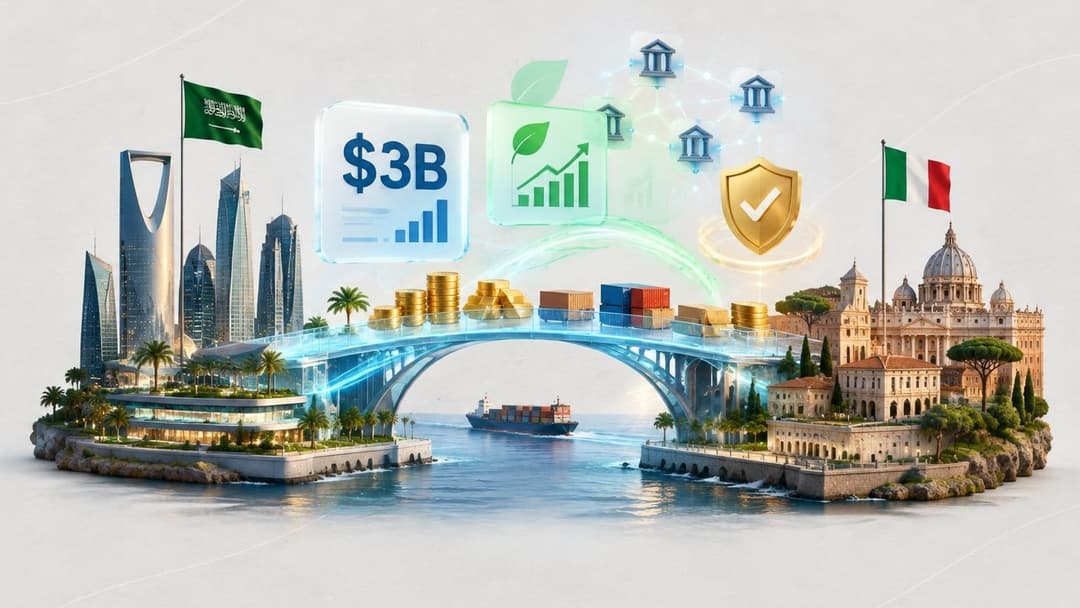
- Saudi Arabia's Public Investment Fund secured USD 3 billion in credit facilities.
- Italy's export credit agency SACE guarantees the financing from 25 international banks.
- The deal comes in two tranches, including a euro-denominated green facility.
- Green tranche proceeds go to eligible projects under PIF's Green Finance Framework.
- Italian suppliers gain a stronger route into PIF and its portfolio companies.
Saudi Arabia's Public Investment Fund (PIF) has secured USD 3 billion in credit facilities backed by SACE, Italy's export credit agency. The financing, provided by a syndicate of 25 international banks with SACE guaranteeing the facilities, is designed to strengthen commercial ties with Italian businesses and widen the fund's access to international financing.
The money comes in two parts: a USD 1.78 billion facility and a EUR 1.035 billion green facility. PIF will allocate the proceeds from the euro-denominated tranche to eligible green projects under its Green Finance Framework.
So what does an export credit agency actually do here? In simple terms, SACE puts its guarantee behind the loans, which makes lenders more comfortable. In return, the arrangement is built to encourage PIF and the companies it owns to buy more Italian goods and services. It's a fairly common trade tool, but the scale here is hard to ignore.
According to the report, the agreement creates additional opportunities for Italian suppliers to work with PIF and its portfolio companies, and gives Italian firms a stronger route into Saudi Arabia's expanding investment ecosystem. Through the facilities, PIF aims to increase procurement of Italian goods and services across its portfolio, while also supporting eligible green projects and deepening commercial cooperation between the two markets.
The deal didn't come out of nowhere. It follows a memorandum of understanding signed between PIF and SACE in March 2025, which aimed to strengthen cooperation between Italian suppliers, PIF and its portfolio companies, and to encourage knowledge exchange between Italian and Saudi companies.
For SACE, the partnership fits its strategy of backing Italian companies in markets with strong export potential. It forms part of the agency's Push strategy, which seeks to increase international procurement of Italian goods and services through financing and business engagement. Spot on for an agency whose job is to help its home exporters win work abroad.
On PIF's side, the green tranche builds on a track record in sustainable finance. The fund was the first sovereign wealth fund to issue a green bond, and it also issued the first 100-year green bond. The involvement of 25 international banks also points to the role global lenders play in its funding strategy, as the fund keeps diversifying its financing sources and instruments.
That said, this is about more than capital. Under its 2026 to 2030 strategy, PIF is also looking to give its portfolio companies greater access to global markets and to attract international capital as they grow. A framework like this one gives those companies easier access to international suppliers and expertise as they expand.
Around Arageek, we often talk about how big institutional deals can shape the wider market for smaller players. To be fair, a credit facility on its own doesn't hand anyone a contract. The real test, as the report notes, is whether the financing turns into concrete procurement contracts, joint ventures and longer-term partnerships between Italian suppliers and PIF portfolio companies.
I reckon the green tranche is the bit worth keeping an eye on. How the EUR 1.035 billion is allocated will say a lot about the direction of PIF's sustainable finance activities, and how effectively financial cooperation becomes real business activity between the two economies.
🚀 Got exciting news to share?
If you're a startup founder, VC, or PR agency with big updates—funding rounds, product launches 📢, or company milestones 🎉 — AraGeek English wants to hear from you!
✉️ Send Us Your Story 👇